
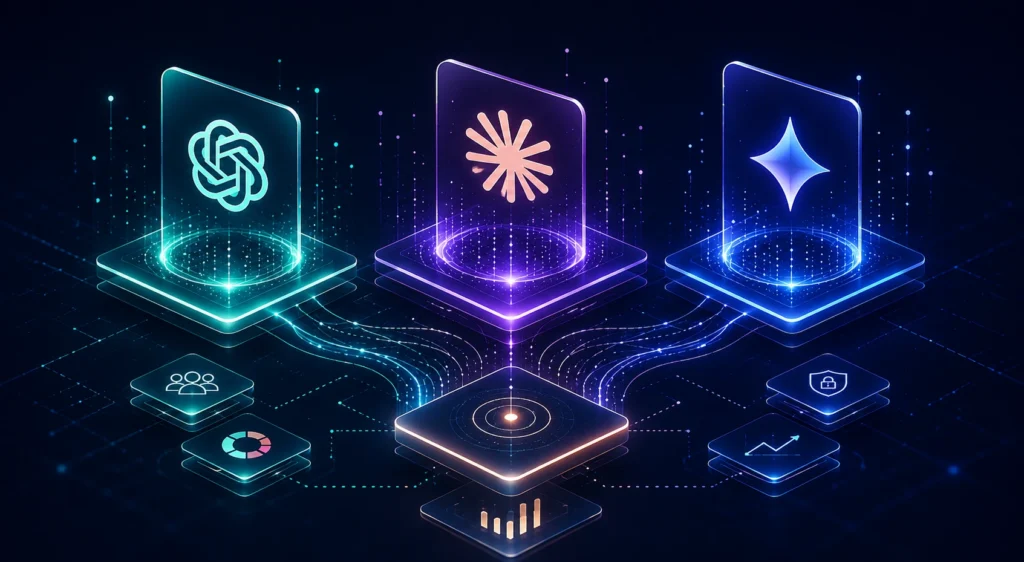

OpenAI vs. Claude vs. Gemini: choosing one for enterprise AI is kind of an impossible task. Unless you know:
- what you’re trying to do.
- who your cloud platform provider is.
- the level of privacy required.
Each of these AI models have different strengths.
For example, OpenAI’s models have the widest possible integration capabilities. And are actually great for the most common enterprise use-cases: chatbots, knowledge management, and customer support.
Anthropic’s models are awesome when it comes to code (54% of the AI coding market).
While Gemini can work with just about anything: audio, images, text, video (multi-modal capabilities). Gemini 3.1 Pro is the cheapest flagship and the right call if your team runs on Google Cloud.
It’s worth noting capabilities in Claude’s models lead. But there’s also a new rising player in this game: Kimi K3.
It scores really close to (and in some areas, better than) Gemini, Claude, or GPT. Plus, it has downloadable weights and a really competitive pricing.
Regardless of everything, enterprises that need reliability, here’s the quickest possible summary: which AI model is right for you depends on two things:
⇀ what you’re trying to replace
AND
⇀ whether you have the correct AI architecture
Written by
The Implementation Team
BEEU TECH — 6+ years delivering great AI tech and talent across all three AI platforms with enterprise teams in the US and India. We don’t resell any of them.
Key Takeaways
- Pick by model strengths. OpenAI, if the goal is org-wide integration. Anthropic wins for code, complex reasoning, and MCP-based integrations. Gemini, if you’re already on GCP or need multi-modal capabilities. Kimi K3, only if you can run 1.4TB of weights and obtain the right license.
- If your org already runs Microsoft Copilot, you already use GPT 5.5. Adoption share at the model layer and dominance at the application layer are two different races. a16z’s survey found Microsoft 365 Copilot still leads enterprise chat (GPT 5.5 is already a default model) and GitHub Copilot is still the AI-coding assistant most enterprise developers actually use — 65% of enterprises say they prefer official partner-driven solutions when one is available, citing trust, integration, and procurement simplicity instead of judging by model capability alone.
- Token efficiency per task beats token price. As of mid-2026, OpenAI and Anthropic now sit in the same flagship price band. Claude Opus 5 is marginally cheaper at $5/$25. The real gap shows up in tokens consumed per task, where Claude uses 40 to 60% fewer tokens on complex long-context threads.
- Most of your workload doesn’t need a flagship. Gartner expects organisations to run small task-specific models three times more than general-purpose ones by 2027. The fastest way to overspend? Running GPT-5.6 Sol or Opus 5 on jobs that GPT-5.6 Luna or Gemini 3 Flash handle with ease.
- The architecture for Enterprise AI depends on the implementation, scalability, governance, and observability. And if not defined well, one may see token costs that are nearly double of employee salaries.
- Model availability is a governance risk. On June 13, 2026, a US government directive pulled Claude Fable 5 and Mythos 5 offline globally — within hours, with no user notice. But was brought back on 1st July for public use. The architecture lesson here: build fallback routing into every agentic workflow through Bedrock, Vertex or Foundry so swapping models is just one config change.
- None of these models should touch your source code, customer data, or trade secrets on any plans. Always deploy the model inside your own private cloud environment, if data privacy is important.
- Adoption isn’t the same as ROI. PwC’s 2026 Global CEO Survey of 4,454 CEOs found only 12% have seen both cost and revenue benefits from AI — and Starbucks, Pizza Hut, and Uber all hit very different versions of the same wall in the last 60 days. And both cases cannot be attributed to the model chosen.
Microsoft Stack → GPT-5.5 via Azure
Code-Heavy Teams → Claude Opus
Google Workspace → Gemini Pro
Large Document Processing → Gemini Pro (Cheaper)/Claude Enterprise with Haiku
Not sure where to start? Use this.
| What you’re trying to replace or build | Start here |
| Document summarization, analysis, report writing | Claude Opus 5 |
| Internal proof-of-concept or tool | Claude Code |
| Rule-based automation (UiPath, ServiceNow RPA) with reasoning | Claude Opus 5 via MCP |
| AI across Microsoft 365 — Teams, Outlook, SharePoint | GPT-5.5 via Azure (default) |
| AI inside Google Workspace with zero setup | Gemini 3.1 Pro |
| Processing very large documents — 500+ pages — in one pass | Gemini 3.1 Pro |
| Regulated or air-gapped deployment | Claude via AWS Bedrock or Vertex AI |
| High-volume, repetitive, cost-sensitive tasks | Gemini 3 Flash |
| Coding Copilots | GitHub Copilot – lets organizations enable Claude, GPT, and Gemini models underneath the same interface. |
One thing to keep in mind: your existing tech stack tells you how hard the integration will be.
It does not tell you which model is right for the job.
Never deploy enterprise AI directly against production systems with write access. Human approval should exist between AI output and subsequent business action.
Hiring AI Engineers? Compare the costs first.
Select your hiring region, choose your team size and compare the true cost of building an in-house engineering team against hiring remotely through BEEU TECH. Includes recruitment costs, employment overheads and projected annual savings.
Who Uses What AI Model In Enterprises?
Forget subscriber counts. Here’s who’s running what, and what happened when they did.
| Model | Customer | What happened |
|---|---|---|
| Claude | Commonwealth Bank of Australia | CBA’s CTO called the Anthropic partnership “foundational to our strategy to become a global leader in AI innovation in banking” — a regulated tier-1 bank committing publicly to one model for fraud and customer service |
| Claude | Salesforce | Projected to spend $300M on Anthropic tokens in 2026 — Claude powers Slack AI and is Agentforce’s preferred model in regulated industries |
| GPT-5.5 | Morgan Stanley | 98% of advisor teams actively use the AI @ Morgan Stanley Assistant for internal knowledge retrieval |
| GPT-5.5 | Cisco | Rolled out Codex org-wide — code review time cut 50%, project timelines went down from weeks to days |
| Gemini | Macquarie Bank | One of the first Australian retail banks to deploy Gemini Enterprise to all employees — not just the tech team |
| Gemini | GE Appliances | 800+ AI agents deployed across manufacturing, logistics, and supply chain — one of the largest published agentic rollouts in industrial manufacturing |
| Copilot | NHS England | Rolling out to 505,000 clinicians and support staff — a prior 30,000-person trial saved 43 minutes of admin time per day, per user |
| Copilot | BNY | Payment validations went from 5–6 minutes to under 30 seconds; open investigations dropped nearly 80% |
Zoom out and the share numbers back this up: 8 of the Fortune 10 are Anthropic’s customers, 92% of the Fortune 500 use OpenAI tools, 80% run workloads through Azure AI Foundry, and 65% of Google Cloud customers are on Gemini products.
Read those four numbers together and the only honest conclusion is that they can’t all be exclusive — and they aren’t. Deutsche Telekom was named a launch customer for Gemini Enterprise and is extending its AI partnership with Microsoft — at telecom scale, in a regulated sector.
Enterprises don’t rely on a single model. It’s all multi-model architecture.
Here’s a table to help you out:
The Head-to-Head: GPT-5.6 Sol vs Claude Opus 5 vs Gemini 3.1 Pro vs Kimi K3 vs Microsoft Copilot
| GPT-5.6 Sol | Claude Opus 5 | Gemini 3.1 Pro | Kimi K3 | Microsoft Copilot | |
|---|---|---|---|---|---|
| Best at | Coding agents, Microsoft integrations, long terminal work | Reasoning, long documents, agentic pipelines, computer use | Large document ingestion, Google Workspace native | Long coding sessions on big repositories | Microsoft 365 — Teams, Outlook, Word |
| Best deployment use-case | Microsoft-stack enterprises, coding agents | Code, proofs-of-concept, multi-system automation, legal and financial analysis | High-volume document processing, Google-native teams | Teams that need to own the model and can run it | Orgs already on M365 that have not made an active AI choice |
| Context window | 400K (~600-750 pages) | 1M (~1,500 pages with larger windows for Enterprise Plans) | 1M (~1,500 pages) | 1M (~1,500 pages) | Inherits M365 document access |
| Data privacy | Enterprise: zero retention on request | Enterprise: zero retention by default | FedRAMP High. Enterprise: isolated within Google Cloud | Self-hosted: your infrastructure. Hosted API: crosses a border. | Governed by Microsoft’s enterprise data terms |
| Integration layer | Microsoft Foundry, Azure AI Search, D365, SharePoint, Teams | MCP, AWS Bedrock, Vertex AI, Microsoft Foundry | Google Workspace, BigQuery, Vertex AI | OpenAI SDK compatible. 12 API providers (like Openrouter), or self-host. | Word, Excel, Teams, Outlook — no separate integration needed |
| Coding | Leads the Artificial Analysis Coding Agent Index in Codex | 79.2% SWE-bench Pro. Joint first on Coding Agent Index in Claude Code. | Weakest of the five on published coding benchmarks | Near-frontier scores, weights downloadable | GitHub Copilot (separate product), runs Claude, GPT and Gemini underneath |
| Honest weakness | 400K context is the smallest here | Seat plus token billing is hard to forecast at agentic scale | Price doubles above 200K tokens | Expensive for an open-weight model, and slow. Licence restricts commercial use. | 85% of Fortune 500 already have it, most without a governance policy |
How the AI Models Score
From OpenAI’s Own Testing:
SWE-bench Pro Terminal-Bench 2.1 DeepSWE OSWorld 2.0 AutomationBench What it tests? Real-world agentic coding Command-line coding Emulates actual software dev behavior Long term complex agentic tasks Cross-application workflows Claude Fable 5 80.0% 83.8% 69.7% — 17.4% Claude Opus 5 69.2% 78.9% 59.0% 54.8% 15.5% GPT-5.6 Sol 64.6% 88.8% 72.7% 62.6% 18.1% GPT-5.6 Terra 63.4% 87.4% 69.6% 50.2% 15.2% GPT-5.6 Luna 62.7% 84.7% 67.2% 45.6% 14.9% GPT-5.5 59.4% 85.6% 67.0% 47.5% 12.9% Gemini 3.1 Pro 54.2% 70.7% 11.8% — —
From Testing Done By Other Labs:
| Model | Score | Source |
|---|---|---|
| Claude Opus 5 | 79.2% SWE-bench Pro, 74.1% DeepSWE, 96.0% SWE-bench Verified, 70.6% OSWorld 2.0, 26.0% AutomationBench | Anthropic |
| Claude Sonnet 5 | 63.2% SWE-bench Pro, 80.4% Terminal-Bench 2.1 | Anthropic |
| Kimi K3 | 88.3% Terminal-Bench 2.0, 67.5% DeepSWE, 30.8% AutomationBench | Moonshot AI |
| Kimi K3 | 32% ExploitBench, 0% ACE cyber range | NIST CAISI and UK AI Security Institute |
From Artificial Analysis Intelligence Index v4.1.1
| Model | Score |
|---|---|
| Claude Opus 5 | 63.0 |
| Claude Fable 5 | 62.1 |
| GPT-5.6 Sol | 61 |
| Kimi K3 | 59.7 |
| Claude Opus 4.8 | 57 |
| GPT-5.5 | 56 |
Sources: Automation Bench ◾ Terminal Bench ◾ DeepSWE ◾ OpenAI ◾ BenchLM ◾ Artificial Analysis ◾ NIST
Two models that are within two or three points of each other on one benchmark, can do the same job in practice. What separates them is cost per task and how well they fit your stack.
Thinking of hiring for AI?
Hire AI engineers from India, the US, and the UAE with BEEU TECH
Built for enterprise hiring. Vetted AI engineers on remote, hybrid, or on-site terms, working in your timezone. A one-week paid trial comes first, you expand or scale down as the roadmap moves, and offboarding runs on 15 days notice.
- One-week paid trial
- Your timezone
- Transparent management
- 15 days notice to offboard
Deployment in as fast as 72 hours. Over six years placing tech talent with enterprise teams and GCCs.
Some Models Don’t Show Up In Comparisons
About 46% of everything running through OpenRouter now goes to Chinese models. On 5 August, eight of the top ten by weekly volume were Chinese. DeepSeek V4 Flash first, Xiaomi’s MiMo-V2.5 second, Tencent’s Hy3 third. Two American models made the list.
Claude Opus 4.8 led on quality through June and ran about 200 billion tokens a day. DeepSeek V4 Flash ran 619 billion.
The best model and the most-used model are not the same model.
Price explains most of it.
MiniMax M3 costs $0.60 per million input tokens.
Claude Opus 5 costs $5.00.
Do not lump these together though. Kimi K3, the one that got the headlines, is not a cheap model.
It costs $3 in and $15 out, more than Claude Sonnet 5 and more than GPT-5.6 Terra.
Artificial Analysis ranks it 97th of 101 on price and slower than most open-weight models its size.
K3 gives you a near-frontier score with downloadable weights, and it charges near-frontier prices for it.
Three things before you act on any of this.
These are usage charts, not quality charts.
Tencent gave Hy3 away free through 21 July. It processed 6.13 trillion tokens in that window. People used it because it cost nothing.
The gap depends on the job.
On routine work most teams cannot tell the difference in a blind test. On hard work they can. Claude Opus 4.8 scores 69.2 on SWE-bench Pro. Hy3 scores 57.9.
On security work the gap is wide.
NIST’s CAISI and the UK AI Security Institute tested Kimi K3 in July. It scored 32% on ExploitBench against GPT-5.6 Sol’s 74%, and solved none of the ACE cyber range challenges.
You also do not have to leave the US labs to get cheap. GPT-5.6 Luna costs $0.20 per million input tokens after OpenAI’s July cut and scores 62.7 on SWE-bench Pro. Claude Opus 4.8 costs 25 times more and scores 69.2.
So the question was never which model is best. It is which tier each job belongs in.
Open Weight Is Not Open Source
People use these two terms as if they mean the same thing. They do not, and the difference lands in your contract.
Open weight means you can download the finished model and run it on your own machines. That is all it means.
Open source, by the Open Source Initiative’s definition, also means you get the training code and enough detail about the data to rebuild the model yourself, with nobody restricting what you do with it.
And here’s what it means for enterprises:
Licences have revenue thresholds.
Kimi K3’s licence says any company above $20M in annual revenue must negotiate a contract with Moonshot before offering K3 to its own customers as a service. Llama needs a separate licence above 700 million monthly users and bans you from training a competing model. If you are an enterprise, you are on the wrong side of at least one of these. Artificial Analysis files K3 under “commercial use restricted” for exactly this reason.
Downloadable does not mean runnable.
Kimi K3’s weights run past 1.4TB. One production copy needs about eight GB300 GPUs. Self-hosting a frontier open-weight model is costly. 🙂
The EU AI Act exemption may not cover you.
It cuts some paperwork, but it does not cover models with use restrictions, and it does not cover systemic-risk models at all. If your plan was to go open source and carry a lighter compliance load, have legal read the licence first.
One number worth sitting with. Open-weight models had their best year in 2026 and enterprise use went down. Menlo Ventures puts open source at 11% of enterprise usage, down from 19%.
OpenAI Vs Claude Vs Gemini: Matching AI Models to Use Case
| Use case | Best fit | Why | What to watch |
| Fast answers, forecasting, internal Q&A | OpenAI | Broadest tool integrations. D365 and SharePoint native. | Employees will paste what they shouldn’t. Governance layer is not optional. |
| Replace RPA with agentic workflows | Claude | MCP architecture purpose-built for connecting to internal systems. Best for multi-step, reasoning-heavy automation. | Needs sandboxed deployment. Not plug-in-and-walk-away. Treat it like a privileged automation tool. |
| Build a POC or MVP | Claude Code | Fastest path from business requirement to working prototype. Claude Code builds functional codebases from high-level prompts. Claude Security (launched April 2026) adds automated vulnerability scanning — targeting production stability by Q3 2026. | Generated code is starting-point quality. Human review before production is mandatory. |
| Google Workspace workflows | Gemini | Native integration is a real advantage. | Data permission hygiene must be in place before deployment. |
| Microsoft-stack enterprise | OpenAI via Azure | Exclusive partnership means enterprise controls, compliance, and data residency within Azure. | Lock-in compounds as you build deeper. Architect for flexibility from day one. |
| Regulated industries (BFSI, healthcare, defense) | Claude via Bedrock or VertexOR Open-Source Models (DeepSeek, Mistral) | Deployable within the existing cloud perimeter. Air-gapped configurations are supported. | Meaningful implementation investment required. Not a SaaS subscription. Infra + MLOps maturity required |
| Business writing (proposals, reports, email drafts) | Claude | Best instruction-following of the three. Output reads like a person wrote it. Handles multi-clause briefs without losing context. | Can be over-cautious on legally sensitive phrasing. For high-volume content generation, Sonnet is cheaper than the Opus model and close in quality. |
Current Flagship Pricing (Updated, August 2026)
One thing has changed significantly since early 2026: the pricing gap between OpenAI and Anthropic at the flagship level has largely closed. This matters for how you think about TCO.
At the flagship tier, OpenAI and Anthropic are now in a similar price band. As a first, Claude is a bit cheaper.
But the more important number is tokens consumed per task — not tokens priced per million.
Enterprise deployments consistently find Claude Opus 4.8 uses 40 to 60 percent fewer tokens to produce equivalent-quality output on complex, long-context tasks.
For high-volume coding or document analysis workflows, this efficiency gap is where the real TCO difference lives.
Gemini 3.1 Pro remains meaningfully cheaper at the flagship level — relevant if your workloads are high-volume and live in the Google ecosystem.
| Model | Tier | Input /1M | Output /1M | Context |
|---|---|---|---|---|
| Claude Fable 5 | Frontier | $10 | $50 | 1M |
| Claude Opus 5 | Flagship | $5 | $25 | 1M |
| GPT-5.6 Sol | Flagship | $5 | $30 | 400K |
| Kimi K3 | Flagship, open weight | $3 | $15 | 1M |
| Claude Sonnet 5 | Mid | $2 | $10 | 1M |
| GPT-5.6 Terra | Mid | $2 | $12 | 400K |
| Gemini 3.1 Pro | Mid | $2 | $12 | 1M |
| Gemini 3.6 Flash | Budget | $1.50 | $7.50 | 1M |
| Claude Haiku 4.5 | Budget | $1 | $5 | 200K |
| GPT-5.6 Luna | Budget | $0.20 | $1.20 | 400K |
Please note:
Sonnet 5 goes to $3 and $15 on 1 September. That is the introductory rate ending.
Gemini 3.1 Pro’s pricing nearly doubles above 200,000 tokens. Past that point, you pay $4 and $18 on the whole request.
Kimi K3 charges $0.30 for cached input, a 90% discount. Which is awesome for coding (where the repo keeps being read).
What this looks like in practice
The scenario: A procurement team needs to review a 180-page vendor contract, flag non-standard clauses, and give the CFO a five-point risk summary.
With OpenAI (GPT-5.5 via Azure): Works well if the contract is pre-indexed into Azure AI Search. Without that, the model reads in chunks — and may miss a clause on page 140 that modifies the liability terms on page 22. The CFO summary is well-structured. If the team is already in SharePoint, the setup is minimal.
With Claude (Opus 4.8): Reads the full contract in one pass. Follows the brief precisely — flags non-standard clauses, ranks them by commercial risk, cites page numbers. The output reads like a careful analyst wrote it, not a tool that ran a search. Best fit for this specific task.
With Gemini (3.5 Flash via Vertex AI): Reads the whole document with room to spare. Fast extraction. Google Search grounding can flag whether a specific clause conflicts with current regulations in real time. More engineering effort if the team is not already in Google Workspace.
So, per Artificial Analysis’s Intelligence Index, one task costs $1.23 on GPT-5.6 Sol and $3.14 on Claude Fable 5. Sol uses 15,346 output tokens per task against Fable 5’s 33,127.
The call for this task: Claude/Kimi K3 for quality. Gemini, if speed and scale matter more.
OpenAI if everything already lives in Microsoft.
One thing all three have in common: the model reads and returns an answer.
It does not write to the source contract. It does not touch the procurement database.
Output goes to a human reviewer. That is how enterprise AI is supposed to work — as an analysis layer, not as a system with write access to your data.
What the invoice doesn’t include
Engineering time to connect the model to your systems.
Security tooling — audit logging, access controls, data loss prevention. Retraining your teams. Rebuild costs when a model version is discontinued.
Deloitte’s 2026 State of AI report found 73% of organizations cite data privacy and security as their top concern. Pricing comes later in the conversation than vendors want to admit.
The implementation layer often costs more than the AI model layer.
What We Actually Think Of Each AI Model
OpenAI / ChatGPT
The Microsoft partnership is the strongest structural advantage in enterprise AI today. If your organization runs on Azure, Teams, SharePoint, or D365, choosing GPT is an infrastructure decision that has already been partially made for you.
The compliance and governance tooling is the most mature of the three. The ecosystem is the widest.
The risk is lock-in: the more deeply you build on Azure OpenAI, the harder it becomes to pivot.
If your organization runs on Microsoft infrastructure, OpenAI is the lowest-friction path to a governed, compliant deployment.
Claude / Anthropic
Anthropic has the most sophisticated architecture for organizations that want to build serious AI capabilities without full ecosystem lock-in. MCP is genuinely valuable.
Claude Code is the fastest route from a business requirement to a working prototype.
On the security frontier: Anthropic announced Claude Mythos Preview on April 7, 2026 — a general-purpose model described as a “watershed moment” for cybersecurity, capable of autonomously discovering zero-day vulnerabilities across major operating systems and browsers. By late May 2026, Glasswing had expanded to approximately 200 organizations across 15 countries.
On June 9, 2026, Anthropic released Claude Fable 5 — a public version of the same architecture, with safety classifiers that automatically reroute high-risk cybersecurity queries to Opus 4.8. Fable 5 posted 80.3% on SWE-bench Pro (the next-best model sat 11 points behind) and ranked first among 317 coding models tested.
Stripe reportedly used it to migrate a 50-million-line Ruby codebase in a single day.
Three days later, on June 12, the US Commerce Department issued an export control directive requiring Anthropic to suspend access to both Fable 5 and Mythos 5 for all users globally, citing a reported jailbreak. Anthropic complied while publicly disagreeing: its review found the technique involved reading a codebase and flagging known vulnerabilities — a capability already present in GPT-5.5 and other public models. Both models went offline on June 13. All other Claude models are unaffected.
But its existence and subsequent signals where Anthropic is investing — and why Claude Security for enterprise (launched April 30, 2026) is more than a feature release.
Here is the honest part: Anthropic’s enterprise support infrastructure is not yet at the scale of Microsoft or Google. It’s growing fast, a bit too unpredictably. Anthropic does provide a deprecation runway (at least 60 days), but it is shorter than what Microsoft or Google provide on equivalent changes (90–180 days of notice).
But as we’ve just seen with Fable 5, that runway is too short.
Additionally, Claude’s billing model — per-seat plus token usage on top — has caused genuine budget unpredictability for enterprise customers running high-volume agentic workloads.
Tl;DR: Heavy usage can cause costs to skyrocket. Plus, whole lotta changes. Factor this into your budget model.
Best for: Code-heavy workflows, complex multi-system agentic pipelines, organizations that need flexibility across cloud providers, security-sensitive engineering teams.
Gemini / Google
The Google Workspace integration is the fastest deployment path for teams already in that ecosystem. Gemini 3.1 Pro at $2/$12 per million tokens is the best price-performance at the flagship level.
FedRAMP High authorization makes Gemini the strongest compliance choice for US federal and regulated-adjacent environments.
The limitation is equally real: outside the Google ecosystem, Gemini’s structural advantage largely disappears. Teams not already in Google Cloud or Workspace will find Gemini requires some engineering for integration — at which point Claude’s MCP architecture often becomes a cleaner choice.
Gemini 3.5 Flash launched at I/O — generally available now via API, Google AI Studio, and the Antigravity platform. Google says it outperforms Gemini 3.1 Pro on coding and agentic benchmarks. Gemini 3.5 Pro is in internal testing, expected by June, 2026.
Google also unified Antigravity as its agent-first development platform for enterprise, with Google Cloud data privacy protections and secure cloud boundary enforcement by default.
Pricing for 3.1 Pro in the table above will update when 3.5 Pro ships.
Best for: Google Workspace-native teams, Google Cloud customers, high-volume multimodal workflows, FedRAMP-required US deployments.
Do note: Gemma 4 shipped April 2026 under Apache 2.0 — fully open-weight, built from Gemini 3 research, in four sizes from 2B to 31B parameters. It’s the only entry on this list backed by a frontier lab that’s also selling you the closed version next door — which tells you something about where Google thinks the real enterprise money is
Microsoft Copilot — The Option Most Organizations Are Already Running
Around 85% of Fortune 500 companies are running some form of Microsoft AI — largely because Microsoft embedded it into existing M365 licenses. But only approximately 3.3% of eligible users have actively paid for Copilot as a deliberate choice.
Most organizations are using AI reactively, inside Microsoft’s infrastructure, without a governance layer. That is not a strategy. It is the default. If your organization is on Microsoft 365, a Copilot access audit — understanding what it already has access to — is often the most important first step before evaluating any other model.
Choosing The Right AI Model Doesn’t Guarantee The Right Outcomes
Three companies found this out in the last month.
Starbucks ran an AI inventory tool — LiDAR sensors, tablet cameras, automated counting — across its North American stores for nine months. Reuters reported it kept confusing different types of milk and missing items on the shelf entirely. In May, Starbucks quietly retired it and went back to counting by hand.
Pizza Hut’s case is the expensive version.
Its “Dragontail” dispatch system gave DoorDash drivers real-time visibility into kitchen timing and order tips.
Drivers did what rational people do with that information — they waited up to 15 minutes to batch the higher-tip orders. Delivery times that used to sit under 30 minutes went past 45 for roughly half of all orders. One franchisee, Chaac Pizza Northeast, filed a $100M+ lawsuit in May, citing a swing from +10% to -10% in year-over-year New York sales after the rollout.
Neither of these can be completely attributed as a “the AI hallucinated” story.
They’re “the AI worked exactly as designed, and nobody modeled what the humans around it would do” stories.
PwC’s 2026 Global CEO Survey — 4,454 CEOs, 95 countries — puts a number on how common this is.
Only 12% report AI has delivered both cost and revenue benefits. 56% report no significant financial benefit at all.
The CEOs who do see returns are three times more likely to have built what PwC calls “responsible AI frameworks” and enterprise-wide integration before scaling — not after.
This is the gap between “which model” and “which architecture.” It’s what the rest of this piece is actually about.
What Comes After Choosing An AI Model?
The model decision is the first question.
The second is: do you have the people to implement it, govern it, and iterate on it?
Most organizations evaluating enterprise AI are doing so because they want to move faster.
The bottlenecks are rarely about the model.
Most times, it’s implementation capacity — the engineers who can connect it to your systems, the security architects who can govern it properly, and the domain experts who can verify whether the output is actually right.
GPT via Azure needs engineers with Microsoft ecosystem depth — Azure AI Search, Dynamics 365, SharePoint. Available in the US market; harder to source cost-effectively in India without a structured pipeline.
Claude via MCP or AWS Bedrock needs engineers who understand MCP architecture, agentic workflow design, and Claude Security tooling. This is the most competed-for profile in enterprise AI right now. Demand is outpacing supply.
Gemini via Vertex AI needs Google Cloud architects comfortable with BigQuery, Vertex AI, and Google Workspace APIs. Strong talent supply in India’s GCC ecosystem.
Which AI model fits your enterprise? — 5 questions
FAQs
Wait, what’s an AI Model? Should Enterprises really care?
An AI model is the engine: GPT-5.5, Claude Opus 4.8, Gemini 3.1 Pro.
To use that, one either needs to open the tool or have an app that your team actually opens every morning, like: GitHub Copilot, ChatGPT, Microsoft 365 Copilot.
Increasingly, the app and the model underneath it aren’t even made by the same company.
a16z’s January 2026 survey of 100 Global 2000 CIOs makes this split obvious:
- 78% run OpenAI in production; 44% run Anthropic (63% including testing) — Anthropic’s the fastest-growing of any lab since May 2025
- Anthropic leads in software development and data analysis specifically. OpenAI still owns chatbots, knowledge management, and customer support — the use cases enterprises adopted first. Gemini is competitive everywhere except coding
- 81% of enterprises now run three or more model families, up from 68% a year ago
And yet: Microsoft 365 Copilot leads enterprise chat, and GitHub Copilot is still the coding tool by enterprise seat count. 65% of enterprises say they prefer an incumbent when one’s available — trust, integration, procurement, in that order. Capability didn’t win that vote. Distribution did.
This is also why two headline stats in this piece don’t actually contradict each other. Menlo Ventures measures which model powers coding work — that’s Claude’s 54%.
a16z measures which app developers sit in all day — that’s still largely Copilot. A developer can open GitHub Copilot every morning while the request underneath increasingly routes to Claude or GPT-5.5. Same seat, different engine, and the engine can change without the developer noticing.
For enterprise buyers, the takeaway isn’t “pick Microsoft” or “pick Anthropic.” It’s that the model decision and the distribution decision are now separate decisions — and architecture that assumes they’re the same is the architecture that breaks when one of them changes.
How should we evaluate these models before committing?
Start with a bounded POC — a single use case, a single team, a defined dataset. Measure task completion quality, not benchmark scores. Run the same prompt across all three models in your actual environment. Then evaluate on implementation friction, data governance fit, and total cost for that specific workflow. Not in the abstract.
What happened to Claude Fable 5?
Anthropic released Claude Fable 5 on 9 June. On 12 June the US government applied export controls. The order took effect immediately and there was no way to check nationality in real time, so Anthropic suspended access for everyone. The controls came off on 30 June. The model came back on 1 July.
Eighteen days.
OpenAI’s GPT-5.6 Sol went out on 26 June to a small group of cleared partners, then opened to everyone on 9 July.
Both labs shipped into an approval process with no published timeline. Neither could tell customers when it would end.
One detail from Anthropic’s write-up is worth pulling out. Its testing found that Claude Opus 4.8, GPT-5.5 and Kimi K2.7 all identified the same vulnerabilities the report was about. Every model it tested could reproduce the exploit demonstration.
What to do about it. Build fallback routing into anything that runs unattended. If your pipeline hardcodes one model and that model goes away on a Friday, you find out on Monday. The teams that did not notice those eighteen days already routed across more than one provider.
This is also why the platform question matters. If you reach your models through Bedrock, Vertex or Microsoft Foundry, swapping one out is a config change. If you built straight against one vendor’s SDK, it is not.