At BEEU TECH, we scanned 2208 live job postings across 314 GCCs in India and the UAE.
The methodology: We went beyond the titles. A title tells you what a job needs. The description tells you what the person actually does all day.
No. of job descriptions read: 668 job descriptions in 3 GCCs.
Our findings:
1. Most AI hiring in GCCs is about predicting things
What GCC AI job titles say
Data Science & ML still outnumbers GenAI 8 to 1
Data science & analytics29.9%
Too vague to sort28.6%
Machine learning (classic)18.8%
GenAI application build6.3%
917 job titles with the words “AI”, “machine learning” or “data”, across 261 companies in India and the UAE. Nearly 1 in 3 were too vague to sort, so the figure 6.3% is a lower estimate.
BEEU TECH · GCC AI hiring scan, July 2026
Look at the numbers:
917 job titles included the words “AI,” “machine learning,” and “data.”
So, what are they actually expecting these hires to do?
Same three tasks every day: training models, building pipelines, and cleaning up training data.
PyTorch and TensorFlow were everywhere in the JDs.
🔸 What that means for the team you are hiring:
This team’s primary purpose may not be to use Gen AI at scale to create text and images. At the core of their tasks might be what enterprises do best: turning your own data into something useful.
Meaning, this team builds stuff that scores, sorts, and forecasts. And answer questions like: Is this transaction fraud? How much stock will we need for March? Is this part of the line likely to be defective?
2. Half the work is just getting the data to work
Out of 54 roles we checked properly, 27 were just building data pipelines. Half. Another 14 were only preparing training data.
Where the hours go
Getting data ready is key
27/54
Include building data pipelines
14/54
Include preparing training data
54 AI job descriptions read in full at three centres. Roles carry several tasks at once, so these counts overlap.
BEEU TECH · AI-hiring Scan, July 2026
🔸 What that means for the team you are hiring:
It’s exactly why a data engineer belongs in your first three hires. No fancy AI model works until your have data, an AI system can work with.
3. Job titles tell only half of the story
Job titles won’t show you what the roles actually expect AI hires to do. Here are two examples from the same data.
Title vs description
The job titles hide what people actually do
Agent work
Says “agent” in the title4.4%
Actually builds agents24%
Evaluation work
Says “evaluation” in the title0.8%
Actually checks output quality31%
Titles from 917 job posts. Work from 54 job descriptions read in full at three centres.
BEEU TECH · GCC AI hiring scan , July 2026
Only 4.4% of titles said “agent. But when we read 54 JDs properly, 17 described checking output quality. And 13 were describing building agents. That’s almost one in four, under different job titles.
🔸 What that means for the team you are hiring:
Niche tasks in AI, like AI evaluation/AI Governance/AI Implementation haven’t completely emerged as unique job titles.
But are parts of other tasks in JDs. Meaning, hiring specialists may require a different approach.
This even applies to Agentic AI developers. People are getting hired in GCCs to build agentic systems but are expected to perform other tasks as well.
4. Tools and frameworks are getting standardized
We came across some 21 different tools. But two do most of the work.
The stack
Standardization’s on the way
PyTorch24
TensorFlow22
Vector databases16
LangChain15
Azure11
Amazon Bedrock4
Google Vertex AI2
21 tools named across 54 job descriptions. Eleven of them appear three times or fewer.
BEEU TECH · GCC AI hiring scan, July 2026
PyTorch shows up in 24 of the jobs. TensorFlow in 22. Vector databases (16 JDs) and LangChain come next. AI evaluation was a task in 17 roles (but only 7 titles out of 917 mentioned it). Azure gets named 11 times. Amazon Bedrock, 4 times. Google Vertex AI, two.
🔸 What that means for the team you are hiring:
It’s great news! The foundations are getting set. Meaning, over time, you’ll have more people to hire who’ve already worked with these tools.
Plus, training your own people is safer because these frameworks will not go obsolete overnight.
The hiring clock
Hiring developers is hard. Nine weeks hard.
That’s the global average for filling one engineering seat. Almost none of it goes on evaluating anyone. It goes on waiting: for the req to clear, for four calendars to line up, for a fifth round that settles nothing.
500+ technologies vettedOwn active benchYour timezone
The AI roles your GCC needs start with what you plan your GCC to do in the first place.
Which AI Roles GCCs Should Hire · BEEU TECH
★ Where most GCCs start
Scoring, sorting, and forecasting based on your own data
→
Data Scientist, ML Engineer
Getting that data usable for AI systems
→
Data Engineer
Building the AI system in the first place
→
AI Engineer
As you grow
Checking the output is actually right
→
AI evaluation — usually shared by QA first
Building agents that take actions in your systems
→
AI Engineer with agentic development experience
Keeping all of it working after launch
→
MLOps, then AI Operations
Deciding which of these is worth doing
→
AI Product Manager
Getting the AI system to work in other locations
→
Forward Deployed Engineer
★
The three highlighted above: Data Scientist/ML Engineer, Data Engineer, and AI Engineer, are where most GCCs start.
The 4 AI roles your GCC’s first engineering team can start with
You’ve seen the data. Now, here’s how you can use that information.
Must-have AI roles in GCCs
AI Engineer / FDE
EARLY
Builds AI into real, working applications and workflows. Later can double as an FDE (Forward Deployed Engineer) and work with product engineers to get closer to a working prototype.
Data Engineer
EARLY
Builds the data pipelines every AI system runs on.
Good-to-have AI roles in GCCs
AI Product Manager
EARLY
Decides what to build, for whom, and how you'll know it worked.
AI Evaluation Engineer
EARLY, SHARED
Checks whether the AI is right, safe, and whether a new release made it worse. Starts as a shared job, becomes full-time later.
These four roles provide a practical starting point for most GCCs developing AI products or internal AI systems.
You do not need to hire all four people in the first month.
Product ownership can sit with existing product management teams.
QA and AI engineering can share AI evaluation. Plus, you may already have data engineers.
💡
BEEU Tip: These four roles exist to get one use case working, start to finish. But who do you hire on month one? The people who will lay the framework to get a use case closer to launch.
The 7 AI Roles Mature GCCs Are Hiring For
Which AI Roles GCCs Should Hire · BEEU TECH
AI Integration Engineer
Connects AI to SAP, Salesforce, ServiceNow, and your internal systems.
Hire whenyou have several enterprise systems to connect
MLOps Engineer
Ships models, watches them, and keeps versions straight.
Hire whenAI goes live
AI Platform Engineer
Builds shared AI infrastructure, so every team stops building its own.
Hire whenseveral AI teams or products exist
AI Security Engineer
Protects the models, data, and tools AI can reach.
Hire whenrisk and scale go up
AI Operations Engineer
Owns AI after launch: cost, speed, monitoring, incidents, and changes.
Hire whenyou run several AI systems live
AI Architect
Decides how the AI apps, data, platforms, and security fit together.
Hire whenyour AI portfolio grows
AI Governance Lead
Owns AI policy, risk, records, oversight, and builds the rules.
Hire whenAI is regulated or company-wide
So, where's this all headed?
Which AI Roles To Hire, By GCC Stage
Most GCCs are of three types:
Either you’re a GCC setting up new teams,
Or one that’s scaling engineering teams.
Or have AI working. As a result, a flat list of eight roles is insufficient.
Find your stage below.
Which AI Roles GCCs Should Hire · BEEU TECH
Tap a stage to see its hiring order.
1
New GCCs : the AI roles to hire first
For new GCCs, the advice is simple. Hire your AI product manager before the first AI engineer. This product manager will set a specific goal for your data and engineering teams to achieve.
This stage has only one job. Get one use case working end to end.Infrastructure for use cases that don't exist yet can wait.
Hire now
AI Product Manager → Data Engineer → AI Engineer (in that order)
Hire next
Analytics Engineer, Knowledge Engineer
Not yet
AI Governance Lead, AI Platform Engineer, AI Architect, Synthetic Data Engineer, AI Security Engineer, AI Operations Engineer, Forward Deployed Engineer
2
GCCs with engineering teams : roles that extend them
You already have engineers. Your gap: injecting AI into real systems and proving it holds up.
Hire now
AI Integration Engineer, AI Evaluation Engineer, MLOps Engineer
Hire next
AI Platform Engineer, Analytics Engineer, Knowledge Engineer, AI Operations Engineer, Forward Deployed Engineer
Not yet
AI Architect, Synthetic Data Engineer, AI Change Manager, Domain AI Specialists
3
GCCs already running AI : roles that help scale
AI teams shift from proving AI works to running it safely at scale. This is also the stage where what you built starts going out to HQ and other offices — so an FDE's need starts here.
Hire now
AI Governance Lead, AI Security Engineer, AI Platform Engineer, AI Architect, AI Operations Engineer, Forward Deployed Engineer
Hire next
Synthetic Data Engineer, AI Change Manager, Domain AI Specialists
Already in place
AI Product Manager, Data Engineer, AI Engineer, AI Integration Engineer, AI Evaluation Engineer, MLOps Engineer, Analytics Engineer, Knowledge Engineer
Here is the thing: if you haven't noticed already, all these AI roles fall into five groups.
Let's dive in.
The 5 Groups Every AI Role In A GCC Falls Into
Which AI role you hire depends on what your GCC is building, how many AI systems it runs, how good its data is, and how far along it is.
But if you want AI to actually work, you need to include all five groups.
1. AI Product Engineering
This area is where AI becomes a real working product, feature, or business workflow.
Group 1
AI Product Engineering
Role
What they do
AI Engineer
Builds the AI system itself. Works across software, models, APIs, and agents.
LLM Engineer
Works on language-model apps: retrieval, context, agents, prompting, and how models behave.
AI Application Developer
Puts AI inside apps your customers and staff already use.
Forward Deployed Engineer
Takes a working system to HQ, another office, or a customer, and makes it fit there.
The first three roles build the system. The fourth role takes it somewhere else and makes it work there.
Two words to take note of:
Retrieval means the system checks company documents before it answers, so the answer comes from internal files.
Agents mean AI that does things inside systems; it clicks buttons, writes files, and updates records.
What teams actually use might surprise you.
We read 668 job descriptions in full. Out of the 54 confirmed AI job postings, PyTorch showed up in 24 roles, TensorFlow in 22. Vector databases came third at 16, ahead of LangChain at 15 and ahead of every managed cloud AI service. Classic machine learning still covers most of the work. And retrieval has moved from experiment to staffing plan.
💡
BEEU Tip: You are testing for working software skills here. Research background matters much less. The best AI engineers look like strong backend engineers who understand how models behave.
↳ Hire when your GCC owns the AI products that customers touch. Build this group before a big MLOps or platform team.
2. AI Platforms
Once you run several AI systems, teams need shared infrastructure. Otherwise, every team builds the same thing over again.
Group 2
AI Platforms
Role
What they do
AI Platform Engineer
Builds the shared parts: model gateways, guardrails, access rules, model lists, tooling.
MLOps Engineer
Ships models, watches them, tracks versions, and keeps them reliable in production.
Infrastructure / Cloud Engineer
Provides the compute, network, storage, and uptime underneath.
Three more words in simple terms: A model gateway works like a door (an internal one) through which all AI requests from each team pass.
Teams handle access, cost, and logging in that one place.
Guardrails are automatic checks that prevent the AI from doing or saying anything it shouldn’t.
Inference is what it costs, in money and time, to run the model each time someone asks it something.
The division between the two engineering roles matters.
Platform engineers build shared parts that other teams reuse.
MLOps engineers take the models, put them into production, and run them.
💡
BEEU Tip: Ask whether they have run shared infrastructure that other engineers depended on. Because you’re hiring for several live AI systems that share the same infrastructure.
Thinking of hiring for AI?
Hire AI engineers from India, the US, and the UAE with BEEU TECH
Built for enterprise hiring. Vetted AI engineers on remote, hybrid, or on-site terms,
working in your timezone. A one-week paid trial comes first, you expand or scale down as
the roadmap moves, and offboarding runs on 15 days notice.
Deployment in as fast as 72 hours. Over six years placing tech talent with enterprise teams and GCCs.
3. Data Foundation
AI is only as good as the data behind it.
Group 3
Data Foundation
Role
What they do
Data Engineer
Builds the data pipelines and storage AI and analytics run on.
Analytics Engineer
Turns raw business data into clean, consistent datasets teams can trust.
Data Quality Engineer
Watches whether the data is accurate, complete, and traceable back to where it came from.
Even the best AI engineers cannot work with data that is missing, messy, or locked away. Not for long, anyways.
💡
BEEU Tip: Ask whether they have worked with data that was already a mess when they arrived.
↳ Hire when: bad data access or quality is slowing your AI work down.
4. Governance & Trust
Build governance while building the product. It costs a lot more to add it after launch.
NIST's AI Risk Management Framework treats governance as the layer that runs through everything else and makes the other three parts work: spotting risk, measuring it, and managing it (NIST AI RMF 1.0).
Group 4
Governance & Trust
Role
What they do
AI Security Specialist
Protects models, data, agents, logins, APIs, and connected systems.
Responsible AI / Risk Specialist
Handles risk checks, human oversight, testing, and records.
AI Governance Lead
Sets policy, approvals, controls, and who is accountable.
This role is particularly important when the work is regulated or has high stakes involved. The EU's high-risk list comprises eight areas. These include hiring, credit scoring, vital public services, and critical infrastructure. (EU AI Act, Annex III).
💡
BEEU Tip: Ask whether they have ever stopped a launch. Governance people who have only written policy have never been tested against a deadline.
↳ Hire when: a regulated or business-critical AI system is heading for launch.
5. Domain AI Expertise
You can reuse the tech across industries. You cannot reuse the business knowledge.
Group 5
Domain AI Expertise
GCC type
Knowledge needed
Manufacturing
Industrial AI, computer vision, predicting breakdowns before they happen
Healthcare
Clinical workflows, medical data
Banking
Fraud, credit, risk, financial crime
Supply chain
Demand forecasting, logistics, stock levels
This role does not always need a new job title. Your existing domain experts can work alongside AI engineers if they already know the process.
💡
BEEU Tip: Ask what a wrong answer costs in their industry.
↳ Hire when: the same specialist knowledge keeps coming up across several AI projects.
The 11 AI Roles Many GCCs Often Overlook
Some of the most useful AI roles sit in the gaps between engineering, product, data, security, and operations.
Hire only for the familiar titles, and you miss them. AI engineer, data scientist, ML engineer. Those three are where most plans stop.
Which AI Roles GCCs Should Hire · BEEU TECH
1 · AI Product Manager
Decides what to build, for whom, and how you will know it works.
The role needs someone who understands what models can and can't do, how to test them, how to keep a human in the decision, and what you give up when you trade cost against speed.
Engineering can construct anything. Someone still needs to decide which thing.
Hire when:you are running several AI use cases, or AI becomes a real part of your roadmap.
2 · AI Evaluation Engineer
Normal software testing cannot determine whether an AI system is effective.
AI evaluation engineers create test sets, benchmarks, scenarios, automated checks, and repeated tests for models, retrieval systems, and agents. They respond to questions like this:
Is the answer right? Is the system making things up? Did that model change actually help? Did this release break something that used to work?
Here is the odd part. This work is already happening inside your center, and almost nobody is hired to do it.
In our own research
Evaluation appeared as a task, of 54 confirmed AI roles17
Evaluation appeared as a job title, of 917 titles7
What that means when you hire: this role is going to become a part of AI engineering, like QA is to software development.
Hire when:your AI systems need constant re-testing. Start with QA and AI engineering sharing it. Make it a full-time job after that.
3 · AI Governance Lead
Evaluation checks if the answer's correct. Governance checks for the risks and legal regulations when the AI system is being used to process data. And the overall security of AI adoption.
69%
PR Newswire reports that nearly 70% of firms surveyed in a Cato Networks survey didn't have a system to monitor how AI was being used — read the survey ↗
In a GCC, an AI governance lead can own:
AI risk checksSign-off on models and appsRecordsHuman oversightProof of who approved whatPolicy and controlsBeing ready for regulators
Hire when:AI goes company-wide, regulated, or high-stakes. Someone to take responsibility for the risk and handle escalations. Handles AI Evaluation and Security teams.
4 · Forward Deployed Engineer
A Forward Deployed Engineer takes something that already works and makes it fit somewhere else.
That somewhere is often a customer. Inside a GCC, it is just as often the parent HQ, another country office, or another part of the business.
Your AI Engineer builds the thing. Your Forward Deployed Engineer goes to the place that wants it and makes it work there.
Demand for this one increased rapidly in 2026. AWS, Microsoft, Google Cloud, OpenAI, Anthropic, Palantir, and McKinsey QuantumBlack are all forming forward-deployed teams.
Forward deployment is not one job. Three profiles come up most:
Forward Deployed Software Engineer
Builds custom integrations and extensions inside the customer's stack. Python, TypeScript, SQL, and REST or gRPC APIs on AWS, GCP, or Azure.
Forward Deployed Solutions Engineer
Makes your existing product fit the customer's process. Less new code, more configuration, data mapping, and workflow design.
Forward Deployed AI Engineer
Tunes retrieval, prompts, testing, and guardrails against the customer's own data and their own edge cases.
Which one you need is determined by what your customers are stuck on. If you make the wrong choice, you will end up with a strong engineer who can't read a room or a strong communicator who can't ship.
The tricky part is that this role requires both at once. They create production code and sit in front of your customers. Most hiring processes evaluate one and hope for the other.
Hire when:your GCC is delivering AI to external customers, and the messy part is deployment. If your engineers are constantly flying out to fix constant issues with the same integration, you already need one.
💡BEEU Tip: Look at your own AI engineers first. The one who built it already knows where it bends. That is the quickest Forward Deployed Engineer you will ever get.
Most companies do not create their own foundation models. They are integrating AI into systems that they already use. SAP, Salesforce, ServiceNow, ERP and CRM platforms, internal applications, and enterprise APIs.
The role covers data flows, logins, getting the steps to run in order, and keeping it all reliable.
Enterprise AI pays off when it's integrated into people's existing workflows.
Hire when:your AI projects are being created to modernize/customize SaaS/enterprise applications with AI.
6 · AI Platform Engineer
Creates shared infrastructure to prevent several AI teams from solving the same problems.
The standard work includes model gateways, the systems that execute the models, guardrails, access rules, monitoring, and tooling for other engineers to use.
Without it, every team rebuilds the same deployment, access, and monitoring setup.
Hire when:several live AI systems keep needing the same infrastructure.
7 · Synthetic Data Engineer
Some AI work needs data that is hard to get, expensive, sensitive, or not allowed. Synthetic data is made-up data that replaces the real thing.
Synthetic Data Engineers create and verify these datasets. They are used for building models, testing, simulations, privacy-sensitive work and those rare cases where you can't wait around.
Hire when:missing data, privacy limits, or simulation keeps blocking you. Treat this as a specialist addition.
8 · AI Security Engineer
AI brings security problems that normal app security does not cover:
Prompt injection — hidden instructions buried in a document or web page that hijack what the AI does next
Data leaks
Model and API abuse
Agent security
Logins and access
What tools the AI is allowed to touch
Sensitive data getting exposed
Once agents have access to your enterprise systems, security must protect the data, logins, connections, tools, and actions within the model. The model is only a small part.
Hire when:your AI interacts with sensitive data, enterprise tools, or performs actions that would be costly to fix.
💡BEEU Tip: An AI Security Engineer reports under the Governance lead and is a part of the AI Evaluation team.
9 · AI Operations Engineer
The first step in developing AI is to make it operational. AI Operations includes everything that comes after: running costs, speed, uptime, monitoring, changes, versions, user feedback, and rollback.
On "drift"
AI changes in quality, cost, and behavior as models, prompts, data, and usage evolve. "Drift" refers to things going downhill, slowly, like, really slowly. The answers quietly deteriorate while everything looks A-Okay!
Our research's 668 job descriptions show GCCs are gearing up to build things, but not a lot of these roles are working on governance.
Hire when:you run several AI systems live.
10 · Knowledge Engineer
This is a newer role, and not every GCC requires one.
Enterprise AI frequently relies on information contained in PDFs, wikis, SOPs, contracts, SharePoint, internal knowledge bases, and business systems.
A Knowledge Engineer organizes this information so that AI can use it. That means building a taxonomy (an agreed set of categories) and an ontology (an agreed map of how your company terms connect to each other).
A better model cannot rescue knowledge that is disorganized or difficult to find.
Hire whenpoor knowledge quality is holding your AI back on multiple projects.
11 · AI Change Manager
AI adoption is both a social and a technological issue. When AI alters how engineers, analysts, or business teams operate, someone must oversee the change.
AI Change Manager is responsible for adoption plans, training, workflow redesign, stakeholder communication, readiness, adoption numbers, and feedback.
You can build AI that works flawlessly and still get very little out of it because nothing has changed in how it operates.
Hire whenAI adoption becomes a large-scale, repeating program. Until then, it can be placed with HR, L&D, or your transformation team.
The 24-Month Problem: Your Month-One Hire May Not Be There By Month Twenty
Most 24-month AI hiring plans fail for one simple reason.
In India, GCCs are seeing attrition in AI and cloud roles running at 18 - 25 %. Average tenure has dropped to just 18 - 24 months. For GCCs overall, it is 16%.
That changes everything. This means that the AI Engineer hired in month one will most likely leave before month 24. The team you end up with is rarely the one you started out with. That's the team that stayed behind.
Salary increments are not solving the problem. The average growth of the GCCs is about 9.8 percent. Top performers make 17.2% . Roles of AI and ML can go up to 21.1%. Even so, these roles have the highest exit rates.
The solution:
Continuity has to be built into the plan itself.
1
Your first five hires are the most critical
1
2
3
4
5
They also take the longest to replace. These people set the direction, and the culture of the teams that will be
2
No single person should hold all the knowledge
Person A
Person B
60%
When two people share 60% overlap, work doesn't stop if one leaves.
3
Everything important needs to be documented
Written down
vs
🚪 Leaves with the person
Test sets, governance calls, and integration details — if it's not written down, it walks out the door.
4
Balance external hiring with internal growth
Grown 3 yrs internally
High-cost, month-1 hire
An engineer who's grown inside the GCC for three years is often far more dependable than a high-cost hire from the market in month one.
Which AI Roles Will Still Matter After 24 Months?
The AI job market is moving very fast. So it is important to know which roles will last and which ones will slowly merge into other jobs.
PwC's 2026 Global AI Jobs Barometer looked at more than a billion job postings across 27 countries.
Jobs that need AI skills are growing almost eight times faster than the overall job market. This means that 69% of job ads require AI skills, compared to only 9% for the overall job market.
PwC also found something particularly noteworthy. In jobs that are highly exposed to AI, companies are now looking for more judgment, leadership, and adaptability.
For hiring, the learning is clear. Focus on AI roles that will remain relevant even when tools and models change. And they will definitely change.
GCC AI HIRING GUIDE · BEEU TECH
Which AI roles are still real in 24 months?
The tools will change inside 24 months. The models definitely will. So pick AI roles that stay useful when they do. Here are 16, sorted by whether the job survives that.
Tap a tier to open it.
✅Durable — hire with confidence 9 roles
These nine hold their shape whatever happens to the tools. Every one of them is a permanent seat.
AI EngineerHire early
Data EngineerBuild early
AI Product ManagementAdd as your AI portfolio grows
AI EvaluationShare early, make it full-time later
MLOpsAdd as live systems grow
AI Platform EngineeringAdd when teams need shared infrastructure
AI SecurityShare early, make it full-time as risk grows
AI GovernanceName an owner early
AI OperationsAdd as more AI goes live
🔶Durable — you just don't need them yet 2 roles
Both are permanent jobs at a bigger GCC. Neither has anything to do on day one.
AI ArchitectureYes, once you're big enough
Add when the setup gets complicated.
Forward Deployed EngineeringYes, once you have something worth replicating
Add when the thing you built needs to work somewhere else. That somewhere is often a customer. Inside a GCC it is just as often HQ or another office.
🔬Specialist — only when something blocks you 2 roles
Real jobs. Narrow ones. You will know when you need one, because something will have stopped.
Synthetic Data Engineering
Only when data or privacy blocks you.
Knowledge Engineering
Only when knowledge blocks you.
❓Not a stable job title yet 3 roles
The work is real. The job title is the part that may not last. Build these into teams you already have.
AI Change ManagementDepends on the work
Usually shared at first.
Prompt EngineeringReal skill, unstable as a job title
Build it into your AI, product, and testing teams.
The 24-Month Plan: Which AI Roles To Hire In Each Phase
Below is a simple 24-month plan for a new GCC starting from Stage 1. If the GCC is already in Stage 2 or 3, the early phases can come earlier.
This is an illustrative scenario. Team sizes are given as planning ranges.
Which AI Roles GCCs Should Hire · BEEU TECH
The 24-Month Plan: which AI roles to hire in each phase
A simple 24-month plan for a new GCC starting from Stage 1. If you're already in Stage 2 or 3, the early phases can come earlier.
Illustrative scenario. Team sizes are planning ranges.
M0M6M12M18M24
🚩Month 18 — your first AI hires hit average tenure
🚩Month 24 — start planning against the Dec 2027 EU date
3–5
8–12
15–20
25–35
Team size by phase
1Foundation · Months 0–6 · Team 3–5
Goal: Get one use case working start to finish.
Move on when: One use case is live with a number attached to it.
New hires: AI Product Manager, Data Engineer, AI Engineer
2Pilot Delivery · Months 6–12 · Team 8–12
Goal: Make the pilot survive real users.
Move on when: Testing runs continuously, hooked into one enterprise system.
New hires: AI Evaluation Engineer, AI Integration Engineer, Analytics Engineer
3Platform Scaling · Months 12–18 · Team 15–20
Goal: Stop rebuilding the same infrastructure per team.
Move on when: Two or more teams share the same infrastructure.
New hires: MLOps Engineer, AI Platform Engineer
4Governance & Rollout · Months 18–24 · Team 25–35
Goal: Make AI safe to show a regulator.
Move on when: Every live AI system has written sign-off and oversight.
New hires: AI Security Engineer, AI Architect, AI Operations Engineer, AI Governance Lead
Want to test this hiring order against your own GCC?
BEEU TECH builds AI and data teams for GCCs across India, the US, and the UAE. Get sample profiles for your current phase and run your own assessment on them.
Not always. You can build some of these roles with your existing teams. It reduces hiring pressure and gives your current engineers a chance to move into better work. Market hires usually stay for 18 to 24 months. People you train internally tend to stay longer.
There is one more reason this matters. Very few companies are building AI talent from the bottom.
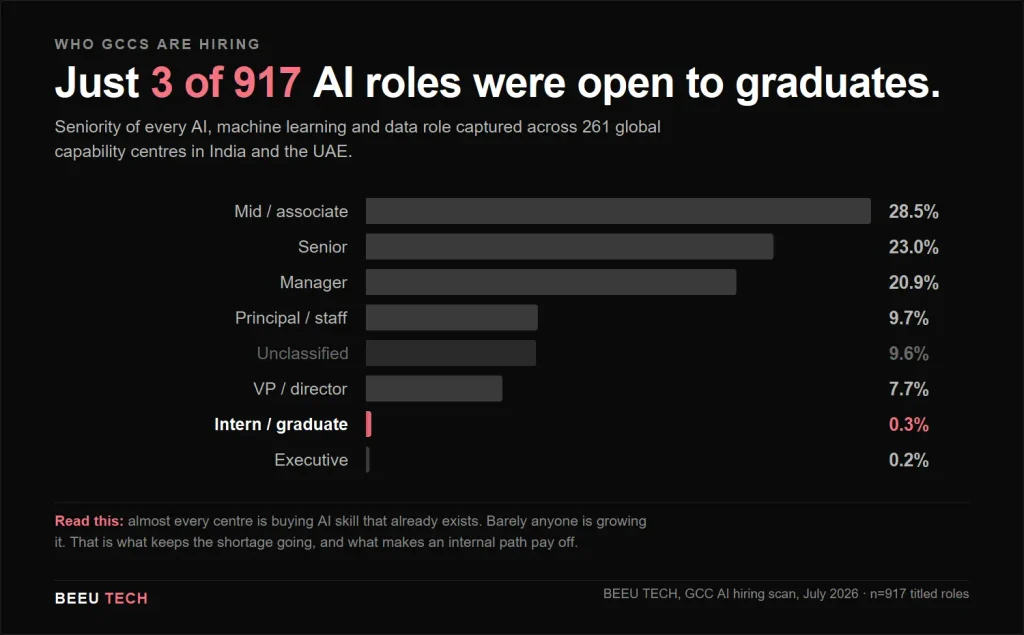
Three graduate roles in 917. Every center is trying to hire from the skilled bracket which is why the shortage never ends.
Creating an internal path is one of the few ways to actually build more talent instead of just competing for it.
HIRE FROM WITHIN
Where your existing team can move into AI
Tap a pathway to see why the move works.
Backend Engineer→AI Engineer
They already know APIs, app architecture, databases, and live systems. With some AI training, they can move into AI app development, model integration, retrieval, and agent work.
QA Engineer→AI Evaluation / Testing
AI needs more than routine testing. QA engineers can build test sets, verify model behavior, find hallucinations, and check output quality after each release.
Cloud Engineer→AI Platform Engineer
Their skills in infrastructure, deployment, networking, and monitoring are directly applicable to AI monitoring and model gateways.
BI Engineer→Analytics Engineer
They're already building data models and reporting pipelines. This move lets them build reusable datasets for the AI team, with clear definitions, tested transformations, and a single source of truth.
Data Analyst→AI Business Analyst
An AI Business Analyst identifies use cases, writes requirements, reviews AI output, and connects technical work to business value. Analysts who already know the business processes are the natural fit.
AI Engineer→Forward Deployed Engineer
They already know how the system works and where it breaks. The new part is the people part — sitting with a team that didn't build it, and getting them to use it.
When to hire externally instead
↻ Hire Internally
Works best when the new role is close to the existing one — skills overlap, context already exists.
↗ Hire externally
Best when you need deep specialists, hands-on production experience, or capabilities not yet developed in-house.
★
It's not about turning every role into an AI role. Develop internally where skills overlap, and hire from outside where the gap is too significant.
The EU AI Act: The Deadline That Can Reorder Your Hiring
Most of your AI hiring is driven by workload. Regulation is different.
It can force you to build governance, risk, records, security, and oversight earlier than you planned. If your GCC supports European businesses, the EU AI Act matters to you. And you need to read the dates carefully, because different rules start on different days. The dates also changed in July 2026.
Do not treat 2 August 2026 as the deadline for all high-risk AI rules. This deadline applied until the EU published its Digital Omnibus on AI on 24 July 2026. It came into force on 27 July, just six days before the old deadline (Gibson Dunn).
Now applies from 2 December 2027 — was 2 August 2026
High-risk AI inside regulated products (Annex I)MOVED — 12 MONTHS
Now applies from 2 August 2028 — was 2 August 2027
Per the Digital Omnibus on AI, Regulation (EU) 2026/1744 — entered into force 27 July 2026.
Two terms to remember:
◽ GPAI means general-purpose AI. These are large models that can do many different jobs.
◽ Annex III is the EU's list of eight high-risk uses. Like: hiring, credit scoring, essential public services, and running critical infrastructure
What this means for GCCs hiring for AI roles?
GOVERNANCE
Ask:
Does our GCC build, deploy, or run AI that creates legal obligations?
And does anyone here actually own them?
If you support regulated or high-stakes AI, governance has to move fast. You need a team responsible for:
●Risk checks
●Keeping records
●Human oversight
●Monitoring & transparency
●Security & data quality
●Audit logs
The Act's rules for high-risk systems
Article 9
Risk management
Article 14
Human oversight
Article 15
Accuracy, robustness & cybersecurity
Among other provisions — this covers the core requirements for high-risk AI systems under the EU AI Act.
Do note that the deadline is 2027.So, there isn't much time to set up approvals, records, and oversight management.
7 Questions To Ask Before You Open An AI Role
BEFORE YOU HIRE
7 questions to ask before you open an AI role
Work out why you need it, whether you can fill it from inside, and whether there's enough work to justify a full-time person. Check off each as you answer it.
1. What will this role enable the business to achieve?
Focus on the outcome. Is it to build an AI product, fix your data, scale infrastructure, improve testing processes, or meet legal obligations? If the goal cannot be stated, the role is not ready.
2. Can we build this capability internally?
Review your existing engineering, data, cloud, QA, and product teams. Training is sometimes the better option when the skills required are similar to those someone already has.
3. Is our data ready?
Hiring won't fix the underlying data issues. Make sure you have the working pipelines, right access, quality checks, and infrastructure the work actually needs.
4. Does this need to be a permanent role?
Not every AI-related skill has to be a full-time job. Is this a one-off project, or will this person's expertise be needed across multiple products, long-term?
5. Is this role shareable?
You may already have expertise in architecture, security, governance, compliance, or domain knowledge. It's often reasonable to share these responsibilities as a first step.
6. How will we measure this person's performance?
Work this out before they begin. Depending on the role: time to market, adoption rates, quality of output, system uptime, operational costs, speed of development, risk reduction, or revenue generated. Measure what they're actually accountable for.
7. What happens to the workload if they leave in 18 months?
Average tenure for AI and cloud roles usually runs 18–24 months, so plan for this transition rather than hoping it doesn't happen. If there's no one to take over, share the role from the outset or have a real handover plan before a second hire.
THE FINAL CHECK
"What will the GCC not be able to build, operate, or own if we don't fill this position?"
A specific answer based on an actual business need is a very good reason. But if the reason is simply that everyone else is hiring for similar positions, the role needs further evaluation.
Frequently Asked Questions
Which AI Roles GCCs Should Hire ▪ BEEU TECH
Which AI roles should a GCC hire first?
Start with the skills needed for one successful use case: AI engineering, data engineering, product, and evaluation. Then add roles to scale and get production-ready — Platform, Security, Governance, Operations.
Are there AI roles a GCC can wait to hire for?
Yes — Synthetic Data Engineer, Knowledge Engineer, AI Change Manager, and Domain AI Specialist can wait until there's a clear, repeating need.
Should every AI role be full-time from the start?
No — for now, integrate testing, governance, integration, and knowledge sharing into existing QA, security, engineering, data, and product teams. Make roles full-time once dedicated ownership is genuinely required.
Can a GCC train current engineers to fill AI skill gaps?
Yes. Backend engineers → AI engineering, QA engineers → AI evaluation, cloud engineers → AI platforms, BI engineers → analytics engineering. Hire externally for specialized knowledge not available in-house.
Will the prompt engineer role remain in demand?
It'll fold into AI engineering, software engineering, product, and evaluation teams rather than exist as a standalone title — much like writing good SQL is a skill, not a separate job.
When should a GCC hire an AI Platform Engineer?
When multiple models or systems need similar shared infrastructure — gateways, guardrails, monitoring, tooling. A single platform engineer for one system is rarely justified.
★ When should a GCC hire an AI Governance Lead?
Appoint one as the company's first point of contact for AI. Make it full-time once AI is regulated, strategically important, or broadly impactful. For GCCs serving Europe: aim for December 2027, not August 2026 — the standalone generative-AI compliance date moved.
What should the AI team size be after 24 months?
No exact number, but a GCC with multiple AI applications should aim for 25–35 people by month 24 — the exact size depends on application count, complexity, and risk.
What's the biggest obstacle to building AI capability?
India GCCs see 18–25% attrition in AI/cloud roles, with average tenure of just 18–24 months — even with a 21.1% salary bump for AI/ML roles. Plan to close gaps through teamwork, documentation, and internal moves alongside hiring.
What's the worst mistake in staffing for AI roles?
Assuming you know what skills you'll need in two years and hiring for them now. Focus on today's skills and let real demand guide future hiring.
What should a GCC that already has AI capabilities do?
Skip the early stages. If AI Engineering and Data are already strong, move to the later phases and focus on the skills you currently lack — Platform, Security, Governance, Operations.
Trusted by conglomerates, enterprises, and startups alike
BEEU Tech’s Agentic AI helped us cut weeks of manual regulatory documentation work down to hours. We freed up critical resources, improved accuracy, and accelerated approvals — directly impacting our speed to market.
CIO
Large Pharmaceutical Company
Partnering with BEEU Tech for our RPO operations has been a huge advantage. They brought in speed, discipline, and market reach that we couldn’t have achieved on our own. Their recruiters quickly adapted to our processes, improved candidate quality, and helped us close niche roles faster. It’s been a seamless extension of our TA team.
Head of Product Innovation
Talent Acquisition Head, Global Services MNC
BEEU Tech’s RemoteHire model gave us the flexibility and depth we needed. Within weeks, we had a 10-member team of data scientists, analysts, and product owners working as an integrated extension of our workforce. Their expertise and collaboration ensured our predictive module went live smoothly and with exceptional quality. It truly felt like having a global team without the complexities of traditional hiring.
CHRO
Predictive Analytics Product Company, Chicago
Get in Touch with Us
Let us know how we can help—share your requirements and we’ll get back to you shortly.
Avg. Reply Time: ~3 hours
Get Your Angular Interview Rubric
What happens when you fill this form: we email you the link to the Angular Interview Rubric. That’s it.
Trusted by conglomerates, enterprises, and startups alike