


TL;DR
- A workforce strategy gap is the space between where your business is going and what your workforce is actually set up to deliver.
- The problems? Timing, measurement, and clarity.
- AI systems act like employees. Orgs haven’t quite caught up with how to measure/manage them.
- Plus: Implementing AI tools has created a 6x productivity divide between the employees using the tools well and those who aren’t
- As a result, 92% of companies plan to hire in 2026. 55% plan layoffs. In the same year. Another gap that doesn’t make sense.
- Most employees don’t know what they’re expected to do with AI. Or how they’ll be measured.
- The fix starts with honesty about what’s actually broken — instead of immediately adding in more tools/restructuring.
JUMP TO:
- What a Workforce Strategy Gap Actually Is
- The Hiring and Layoff Paradox
- The Divide Opening Up Inside Your Organization
- Why Employees Are Confused — And Why That’s a Leadership Problem
- The Seven Workforce Strategy Gaps That Came With The AI Era
- What Organizations Can Do To Close Workforce Strategy Gaps
- A Quick To-Do List To Take On These Changes: For Leaders & Employees
- How BEEU TECH Can Help Close Workforce Strategy Gaps
What a Workforce Strategy Gap Actually Is
Simple version.
Your business has goals. A direction. A plan for where it’s going.
Your workforce — the people you have, the skills they carry, and the structures they work inside — either lines up with that plan or it doesn’t.
When it doesn’t? That’s the gap.
Most textbook definitions call it the distance between what your organization needs to execute its strategy and what your talent strategy is actually built to deliver.
But the gap has always had a hidden dimension: timing.
It’s not just whether you have the right skills. It’s whether you’ll have them when you need them.
Workforce Gaps are generally divided into 4 types:
👉 Skill Gaps
Your current employees don’t have the core skillsets required to be in sync with upcoming initiatives or industry benchmarks/trends. The most common gaps that we’ve seen in our 6 years of talent delivery experience? AI, Cloud, and Data Engineering talent.
👉 Location Gaps
Can mean many things: employees don’t work where and when your core teams work. Your talent infrastructure is distributed across the world, making it harder to co-ordinate and align on shared outcomes.
👉 Headcount Gaps
You have too much staff or the exact opposite. And the future projections aren’t there to support either.
👉 Budget Gaps
The current workforce costs more than the projected spend or you aren’t spending enough to attract or upskill existing/necessary talent.
A quick workforce gap example:
You might have great engineers today. Say, you’re planning to make your product’s documentation searchable and integrated with an agentic QA system.
So, your roadmap requires AI-native engineers 18 months from now. That’s a workforce strategy gap — even if nobody has been laid off and nobody is complaining.
Because:
a) you need to evaluate whether the talent you’re going to need is to be hired or upskilled from within the org
b) the cost of this hiring/upskilling/automation is still going to have to meet you in your budget planning
c) you need the talent working where you work, when you work
Now, AI has made this timing problem significantly worse. And here’s why:
It’s added a third dimension that barely existed five years ago: clarity.
That AI talent you need has to be sourced, vetted, deployed, and actively managed.
By teams within your org.
And your people may not know what they’re supposed to be doing with AI.
If the output is even up to the standard.
How they’ll be measured.
Whether their role is stable or quietly being redesigned around them.
That uncertainty is a gap in itself.
What’s The Real Cost of Hiring Engineers In-House?
Select your hiring region, choose your team size and compare the true cost of building an in-house engineering team against hiring remotely through BEEU TECH. Includes recruitment costs, employment overheads and projected annual savings.
The Hiring and Layoff Paradox
Here’s a number that shouldn’t make sense — but does.
A December 2025 survey of 1,000 U.S. hiring managers by Resume.org found:
- 92% of companies plan to hire in 2026
- 55% plan layoffs in the same year
Hiring and cutting. Simultaneously.
The top reasons for layoffs: AI (44%), restructuring (42%) and budget constraints (39%).
Might feel like a contradiction.
Especially, when AI spending is skyrocketing.
This is just the workforce strategy gap becoming visible.
Organizations are cutting roles they believe AI has made redundant.
And scrambling to fill roles they can’t automate — or roles they want to automate at lower cost.
And this is exactly what happens when workforce strategies skip the basic part: scenario modelling.
The problem is the bet.
BCG’s April 2026 analysis of 165 million U.S. jobs found that 50–55% of jobs will be substantially reshaped by AI over the next two to three years.
Reshaped — not replaced.
BCG’s warning is worth reading twice:
“Those who cut their workforce beyond AI’s ability to replace it will see productivity drop, institutional knowledge disappear, and critical talent walk away.”
Boston Consulting Group
That’s already happening.
Organizations that moved aggressively on AI-led restructuring are now restoring some of the positions they cut.
Plus, fresh data from Fortune reports that the bets made in favor of AI to trigger layoffs are not paying off well.
The workforce strategy gap here isn’t about moving too slowly on AI.
It’s about restructuring before understanding what AI systems CAN and CAN’T actually replace.
And also asking these two basic questions when it comes to execution and evaluation factors during workforce analysis:
What happens if AI costs more than employees? Or generates a different kind of role than we anticipated?
The Divide Opening Up Inside Your Organization
This is the one that most leaders aren’t watching closely enough.
OpenAI’s State of Enterprise AI 2025 report analyzed usage data across more than 1 million business customers.
One finding stands out:
Frontier workers — those in the 95th percentile of AI adoption — generate 6x more messages than the median worker. In data analysis roles alone, that gap stretches to 16x.
And it’s not that the organizations (that were surveyed) were tooled unevenly.
Everyone had the same access.
And the workforce strategy gap that exists right now?
How deeply employees are using these AI tools.
And the gap widens with task complexity.
For coding, frontier workers send 17x more messages than the median. For writing, 11x. For analysis, 10x.
This means two employees in the same role, with the same tools, can have wildly different output.
And most performance systems have no way to detect why — or to measure the difference accurately — or for that matter detect if the work even holds.
A 2025 BCG study referenced in the OpenAI report found that AI-leading organizations achieved 1.7x revenue growth and 3.6x greater total shareholder return compared to laggards over three years.
That gap compounds.
The workers and firms that are behind today are getting further behind every quarter — not because they lack access, but because the adoption isn’t there yet.
And adoption is rarely a license or a course completion certificate.
True adoption = learning that delivers quality output.
And with that come two dangerous precedents, which start with confusion.
Why Employees Are Confused — And Why That’s a Leadership Problem
Here’s a question most organizations haven’t answered clearly:
Does your team actually know what they’re expected to do with AI?
Not “do they have access to AI tools.” Not “have they completed the AI training module.”
Do they know:
- Which tasks they’re expected to use AI for?
- How their performance will be measured in a world where AI can do parts of their job?
- Whether their role is being redesigned — and if so, into what?
Most employees don’t. And that’s not their failure.
McKinsey’s 2025 AI in the Workplace report found the biggest barrier to scaling AI inside organizations is leadership — not employees.
Employees are experimenting.
They’re adopting tools.
Some are racing ahead.
Some are waiting for direction that hasn’t arrived.
And in the middle, you get shadow AI — people using tools without governance, without standards, without anyone knowing the output quality varies wildly between teams.
At the bottom of the org chart, people are asking three questions they aren’t getting straight answers to:
- How am I supposed to use AI in my job?
- How will I be evaluated when AI is part of my output?
- Is my role still mine?
- If I show I am using AI, will I get promoted?
Those questions don’t go away when you ignore them.
They turn into disengagement, inconsistency, and quiet attrition.
Or worse, promoting people who are at best just able to generate more volume, but not impact-driven outcomes.
Over 90% of organizations expect to be impacted by the IT skills shortage by 2026, with an estimated $5.5 trillion in lost productivity tied to the gap (IDC).
That number doesn’t shrink by buying more tools. It shrinks by closing the clarity gap.
The Seven Workforce Strategy Gaps That Became More Noticeable With The AI Era
Gap 1: AI Literacy at the Top
Leadership mandates AI adoption. But most executives don’t have a working understanding of how AI changes workflow quality, output verification, or productivity measurement.
They understand the headline. They don’t understand the operations.
That creates a specific problem: decisions about restructuring, headcount reduction, and performance standards get made by people who are working off assumptions — and those assumptions are often wrong.
McKinsey is direct on this: leadership is the bottleneck, not employees.
Gap 2: Productivity That Isn’t Real
AI produces output. Lots of it. Reports. Code. Decks. Emails.
But producing more doesn’t mean doing better.
Most organizations still measure hours, task completion, and visible activity. AI inflates all of those cheaply. An employee can look more productive while actual decision quality stays flat — or drops.
BIS research on AI productivity found that gains are uneven and depend heavily on training, data infrastructure, and workflow design. They don’t arrive automatically with tool access.
Activity that looks like productivity — but isn’t — is a strategy gap with a delayed bill.
Gap 3: Performance Systems That Haven’t Caught Up
One person using AI well can outperform a whole team.
But traditional performance systems weren’t built to detect why. They measure what happened — not how judgment, quality, or decision-making contributed.
This leads to bad promotions. Wrong restructuring calls. Misreading which teams are actually strong.
Gap 4: Shadow AI
Employees are adopting AI unevenly. Quietly. Without governance. Without consistent standards.
Some teams are weeks ahead. Others are barely using it. And almost nobody has mapped out what the workflow looks like when AI is involved — so output quality varies in ways that aren’t visible until something fails.
Gap 5: Organizational Design That Jumped the Gun
Flattening management layers and restructuring teams are real responses to AI efficiency. Sometimes they make sense.
But many organizations are doing this before they understand what those management layers were actually doing. Before they know which oversight functions were keeping quality intact.
When you remove a layer, you don’t just remove cost. You remove whatever that layer was doing.
Gap 6: Capability Allocation
Not every team benefits equally from AI.
Marketing content velocity goes up. Legal review slows. Data quality issues stay. Operations get overloaded because AI sends more work to decision making teams than they can process.
So automated teams like customer engagement ops, decision-making, compliance – without human interaction – are a logistical and planning nightmare.
Gap 7: Hiring Is Actually Not Faster
In 2026, companies are conducting 42% more interviews per hire than they did in 2021.
What used to be a phone screen and two rounds has expanded into four, five, sometimes six rounds — with panels, take-homes, culture calls, and multiple stakeholder sign-offs.
Each additional round adds 3–7 days to the hiring timeline.
And the average time-to-fill is already sitting at 45 days. For senior or specialized tech roles, it often stretches to 90+.
Here’s the problem that number hides: the best candidates are off the market in 10 days.
So by the time you’ve run your five-round process and made your decision, you’re offering the role to your third or fourth choice. Your top candidate signed somewhere else on day 11.
In some ways it has — recruiters report a 30% productivity lift from AI screening tools. But there’s a cost.
Only 26% of candidates trust AI to evaluate them fairly, according to Gartner. SHRM’s benchmarking found that AI-first screening correlates with worse candidate experience, more ghosting, and higher cost per hire.
It’s easy to say that high application volume has emerged as the second biggest recruiting challenge in 2026 — with most of that volume driven by AI-assisted applications flooding pipelines.
The AI tools that were meant to reduce noise are also generating it.
Candidates use AI to write applications. Employers use AI to screen them out.
Both sides optimizing against each other — and actual qualified humans getting lost in the middle.
Gartner research projected that by 2028, one in four candidate profiles globally could be fake. A CBS News investigation found that roughly 50% of employers have encountered AI-driven deepfake fraud in some form by early 2024.
The hiring process is turning into an arms race.
And in an arms race, the casualties are usually the best candidates — the ones who don’t need to game the system because their actual work speaks for itself.
Gap 8: Top Down Communication Truly Doesn’t Exist
HRM’s job is to align on workforce analysis with departmental heads. Exec Leadership aligns with HRM. Everyone aligns. Yet, somehow or the other, all three are almost never taking calls on the same thing in the same room.
Workforce gaps occur because of this sole reason. CFOs, CHROs, CTOs, L&D, CMOs, HROps, Data Teams, Department Heads, and any other decision makers in the entire org chart must align to truly close the workforce gap.
Why: understand whether the workforce has the right skills and coordinate around labor market + forecasting data to conduct a thorough workforce gap analysis – which in turn helps formulate the right workforce planning implementation – in sync with talent supply and demand. This, of course, won’t ever be done completely if any one of the above-mentioned, aren’t in the loop.
What Organizations Can Do To Close Workforce Strategy Gaps
AI systems are generating work. Other AI systems are monitoring work. Humans are validating both.
And almost nobody has clear visibility into:
- Whether the AI-generated output is actually good
- Where bottlenecks have moved in the workflow
- Which skills actually matter now
- Which team structures are quietly breaking
So, before deciding what to do, organizations need to answer three questions simultaneously:
1. How can the current workforce adapt?
Not “can they be trained on AI.” Specifically: which existing employees are closest to the capabilities the business needs next? Which roles can evolve with some investment? And how long will that take?
2. Which workflows or processes should change — not just the people in them?
Some gaps aren’t talent gaps at all. They’re process gaps. A workflow that was designed before AI existed may be creating friction that no amount of hiring or training will fix. The question isn’t always “do we have the right people.” Sometimes it’s “are we asking the right people to do work that makes sense.”
3. Which capabilities don’t exist internally and need to come from outside?
And when they do: are they permanent requirements or time-bounded ones?
This last question gets overlooked constantly.
This is why, the first fix starts with:
1) The First Thing To Fix Is Observability, Not Headcount.
Before expanding the team, restructuring, or committing to a new capability investment, organizations increasingly need to understand what is actually happening inside their current workflows.
That means going beyond the metrics that have always been easy to track.
Ticket completion rates and velocity are not sufficient signals anymore.
Organizations need visibility into:
– time spent in re-reviewing
– correction frequency
– AI usage patterns across teams
– coordination overhead between functions
– whether productivity improvements at the task level are actually improving business outcomes.
A team generating twice the content output is not necessarily a stronger team. A team shipping more code is not necessarily building better products.
The difference between synthetic productivity and real productivity is hard to detect without better observability infrastructure or better workforce management tools.
However, this is not a technology problem alone. It is in those assumptions made during workforce planning.
Most workforce strategies were built around the idea that visible activity roughly tracks with valuable output.
That assumption is now unreliable in AI-assisted environments.
The organizations making the best workforce decisions right now are the ones that added observability before they added headcount.
2) Treat AI Utilization The Same Way You Treat Workforce Utilization.
AI systems are doing work inside your organization. If you are not tracking how that work is distributed, you have a blind spot in your workforce planning.
OpenAI’s State of Enterprise AI 2025 report found that frontier firms generate seven times more messages to custom AI tools than the average enterprise firm
Same tools. Very different utilization.
If 20% of your team accounts for 80% of AI usage, you have purchased enterprise-scale capability running at single-team output.
The same utilization logic that applies to people applies here.
Are the right teams using AI tools effectively?
– Is adoption concentrated in a handful of power users while the rest of the organization barely touches it?
– Is AI usage reducing overall workload, or is it redistributing it somewhere less visible?
– Are the employees using AI most heavily the ones with the clearest governance, or are they operating in a shadow workflow that nobody is monitoring?
These are workforce planning questions. They just happen to involve tools as the subject rather than people.
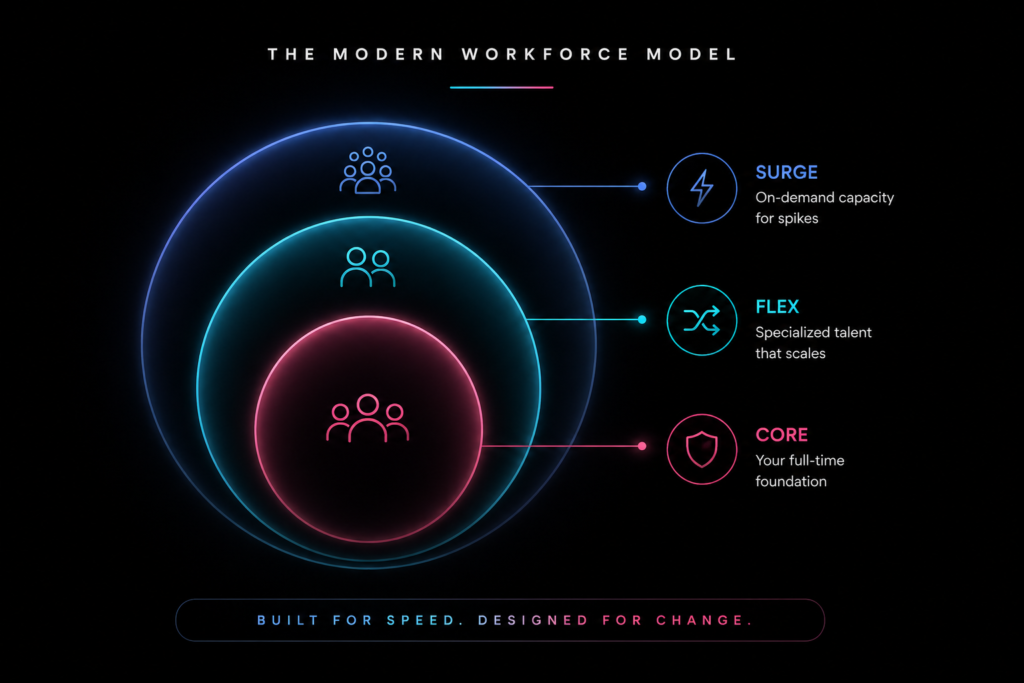
3) Not Every Capability Need Is Permanent. Plan For That.
One of the more consistent workforce planning mistakes right now is treating every capability need as a long-term hiring decision.
Some capabilities are permanent.
You will need them regardless of how tooling, markets, or organizational structure shift.
Some are transitional. They are critical for twelve to eighteen months while a system gets built, a migration gets completed, or a new operating model gets stood up. Then the intensity drops and the role evolves or exits.
Some are project-based. Defined deliverable. Defined endpoint.
Some are maintenance-oriented. Ongoing, but not expanding.
And some will be automatable later, even if they require humans now.
Organizations that do not distinguish between these categories end up with permanent headcount commitments against needs that were always time-bounded.
Or they underinvest in capabilities that are genuinely long-term because they treated them as temporary. Both are expensive errors, just in different directions.
Temporal capability planning is not complex.
It mostly requires asking one honest question before each significant hire:
is this a permanent requirement or a transitional one?
The answer changes the hiring model, the engagement structure, and the planning window.
4) Do Not Treat Workforce Strategy Gaps As Skill Gaps.
A common pattern right now: organizations hire AI engineers to build new systems, then discover they need far fewer of them to maintain those systems once they’re live.
That’s not a planning oversight — it’s a predictable capability lifecycle. The oversight is treating every hire as permanent infrastructure when some roles exist to deliver a transformation and then exit.
Which is why we say: You can close a skills gap and still have a workforce strategy gap.
A skills gap is a missing capability. A shortage of cloud engineers. Lack of AI implementation expertise. Cybersecurity capacity that hasn’t kept pace with threat exposure. It’s specific — you can point at the hole in the wall.
A workforce strategy gap is broader. It includes skills shortages, but it also captures everything that determines whether the right capabilities are available, deployable, and productive at the time they’re needed.
For example, the workforce strategy gap happens if a bunch of newly trained/hired people aren’t in the right roles, or aren’t ready at the right moment, or are sitting in a team that doesn’t have the delivery infrastructure to use them.
The distinction matters because the fixes are different.
Skills gaps get closed through hiring, upskilling, and reskilling.
Workforce strategy gaps require changes to how planning, hiring timelines, onboarding, and operational delivery are coordinated.
Organizations that treat a workforce strategy gap as a skills gap keep hiring and keep falling behind.
5) Have Better Learning Configurations.
Workforce gaps don’t only come from talent shortages. They also emerge from:
- Slow onboarding-to-productivity cycles that keep new hires below full output for months
- Poor knowledge transfer systems which means institutional knowledge walks out the door every time someone leaves
- Workforce development programs that run in isolation from actual operational work — certifications that don’t change what people do on Tuesday morning
- Unclear performance expectations in an AI-assisted environment, where nobody’s been told what “good” looks like anymore
OpenAI’s enterprise usage data offers a useful signal here.
Deeper AI users — the ones saving 10+ hours per week — spend significantly more time using AI for learning and workflow improvement than lighter users.
They’re not just doing tasks faster. They’re building capability inside the work itself.
That pattern has an implication for how organizations think about training.
Capability development that’s embedded directly into real workflows compounds over time. Meaning: AI-assisted on-boaring, KTs, etc.
The organizations adapting fastest aren’t running more training programs — they’re building better learning conditions inside the work that already exists.
6) Be Human First. AI Second.
AI efficiency is real. But AI shouldn’t become the justification for cost-cutting that the business case can’t actually support.
The fundamental metrics haven’t changed. CSAT, NPS, margin, market share — those still need human judgment to move meaningfully. Efficiency gains that degrade customer experience or destroy institutional knowledge aren’t gains. They’re deferred costs.
BCG put it directly: organizations that cut their workforce beyond AI’s ability to replace it will see productivity drop, institutional knowledge disappear, and critical talent walk away.
That’s already happening.
Many organizations that moved fast on AI-led restructuring are now reversing those decisions.
The goal is sustainable scaling — not headcount reduction dressed up as transformation.
7) Succession Planning Is Not Only For Top Leadership.
Most succession planning stops at the VP layer. It shouldn’t.
Pareto’s principle applies here.
A small number of people — often senior individual contributors and team leads, not always senior titles — carry a disproportionate amount of operational continuity. When they leave, the knowledge transfer process is the only bridge. And KT is almost always under-resourced and under-timed.
The right question for succession planning isn’t “who’s next in line for leadership.” It’s: which roles, if they went vacant tomorrow, would cause the most operational damage?
Map those roles. Document the knowledge.
Build the handoff structures before they’re needed.
Onboarding time and knowledge transfer are shrinkage — they reduce effective capacity just like attrition does.
Organizations that plan for shrinkage explicitly, rather than treating it as an unavoidable cost, protect execution continuity in ways that headcount numbers alone never will.
8) Have a non-disputable department for Workforce Planning
You don’t need to hire new people. Just conduct a quick workforce analysis.
Are there people in your org’s structure can step up to the need? Or do you need to bring in external help?
Run checks on if have:
- C-Level execs who know the financials
- HROps for labor market data, everyday ops, compensation, and other benchmarks
- Data Engineers/Scientists for data modelling and forecasting
- L&D to guide on existing and future upskilling ops
- Talent Acquisition for supply and demand trends
To put simply, you need decision makers, financial planning, people planning, learning planning, and actual ground level managers in the same room, in one department.
A Quick To-Do List To Take On These Changes: For Leaders & Employees
What To Do: For Execs
Define what AI-enabled performance looks like — before you measure it.
Employees can’t close a gap they don’t know exists. Tell them which tasks AI should be part of, what quality standards apply, and how output will be evaluated. That’s not optional — it’s the baseline.
Stop measuring activity. Start measuring judgment.
AI makes visible output cheap. The valuable thing now is decision quality, problem framing, and the ability to verify AI work accurately. Build that into how you evaluate teams.
Run productivity validation before restructuring.
Before cutting headcount based on AI efficiency assumptions, measure actual output quality, review burden, and error rates. Efficiency gains that increase verification cost may not be net gains.
Make leadership AI literacy operational.
Understanding what AI is isn’t enough. Leaders need to understand how it changes workflow quality, where it fails silently, and what oversight structures need to exist. That’s the literacy that drives good decisions.
Build observability into your workflow infrastructure.
You need to know how AI is being used across teams — not just whether tools are active. Usage patterns, review burden, correction frequency, and coordination drag are all workforce planning inputs now.
What to Do: For Managers and Employees
Ask your manager for clarity — specifically.
If you’re unsure how you’re expected to use AI, or how your performance will be measured, ask directly. “Which tasks should I be using AI for?” and “How will my output quality be evaluated?” are reasonable questions. If leadership hasn’t answered them at the organization level, push for a team-level answer.
Map your role against what AI can and can’t do.
Look at your responsibilities. Which tasks does AI accelerate? Which require judgment that AI can’t reliably provide? Where is your actual value in the workflow? Getting clear on this is a career move — not just a productivity exercise.
Don’t use AI secretly.
Shadow AI is the fastest way to create quality problems that damage your reputation. If you’re using tools that aren’t part of your official workflow, document what you’re doing and surface it. The governance conversation is better than the accountability conversation after something goes wrong.
Build verification as a skill.
AI output needs to be checked. The people who can do that reliably — who know what good looks like, who can catch the subtle errors — are going to be more valuable than the people who just produce volume. Develop that skill deliberately.
How BEEU TECH Can Help Close Workforce Strategy Gaps
Many workforce strategy gaps today happen because businesses are trying to adapt to AI, changing workflows, and new delivery demands faster than internal teams, hiring systems, or workforce operations can keep up.
BEEU TECH operates on the core belief of: Right Talent. Right Now.
We help enterprises and GCCs in the US, Middle East, and India respond and adapt faster through embedded hiring, workforce augmentation, and workforce operations support across tech, data, design, and operations.
This helps them:
- bring in specialized talent for AI and transformation initiatives,
- extend delivery capacity without overloading internal teams,
- build internal capability while maintaining operational continuity,
- and scale teams flexibly as workforce needs evolve.
Want to take a peek at how we deliver at scale? Talk To A Workforce Ops Expert
Sources: Resume.org Survey Dec 2025 · BCG AI Jobs Analysis 2026 · OpenAI State of Enterprise AI 2025 · McKinsey AI in the Workplace 2025 · IDC/Workera Skills Gap Report · Forbes: AI Layoff Regrets · WEF Future of Jobs 2025 · BIS Working Paper on AI Productivity