


The first 10 engineers are easy.
The next 90 determine what your GCC becomes.
What works at 10 engineers won’t work at 100. As your team grows, so must your engineering structure, leadership, and operating model.
Only 5% of India’s GCCs have become Transformation Hubs, while 43% remain Satellite centres, according to Zinnov and Nasscom.
This playbook shows how to build an engineering organization that scales from 0 to 100 engineers.
If you haven’t yet decided whether to hire, augment, or use AI for this capacity, start with Hire, Augment, or AI? The GCC Leader’s Playbook – this piece picks up once that call is made.
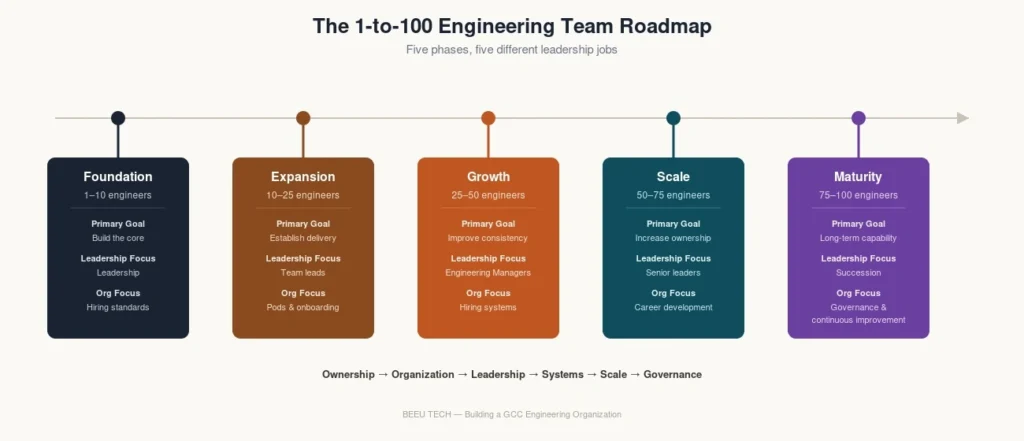
The roadmap above shows how leadership, team structure, operating systems, and governance evolve as your GCC grows from its first engineer to its first 100. The rest of this playbook follows that journey step by step.
Each stage introduces a different organizational challenge.
And for each step, we’ve included practical frameworks, templates, checklists, and scorecards that you can adapt as your GCC grows.
But first:
The ratios we build against:
- One Engineering Manager per 8–10 engineers
- One Tech Lead per pod
- One Staff Engineer per 2–3 pods
- One senior/staff engineer per 3–4 juniors
- Architecture reviews every two weeks
Before Engineer #1
Step 1: Define How Your GCC Will Operate Before You Hire
Before hiring begins, define how the engineering organization will operate – not just how many people it will contain. Clear decision rights, reporting lines, leadership responsibilities, and team boundaries create consistency as the organization grows. Without these foundations, teams grow faster than the systems that support them.
Each engineering organization should establish:
- Product scope – what each team owns 100% end-to-end
- Decision-making authority – tooling, hiring, architecture, and incidents
- Success metrics – organizational effectiveness, engineering health, and delivery quality.
Template: One-Page Charter
Build it, don’t just fill it in
Set decision rights per item, name your metrics, and get a signed-off charter ready to paste into HQ’s doc. Saved automatically in this browser.
🟦 Leadership Principle:
Before Engineer #1 joins, decide on decision-making rights with Headquarters. Undefined decisions tend to escalate rather than remain neutral.
A signed charter is a claim about what the centre will decide for itself. It’s worth exactly as much as the person holding it, which is the next decision and the harder one.
Step 2: Hire the Right Leaders Before You Hire More Engineers
The first 10 aren’t about capacity. They’re about who makes the call when you’re not in the room. The order becomes the standard for future hires.
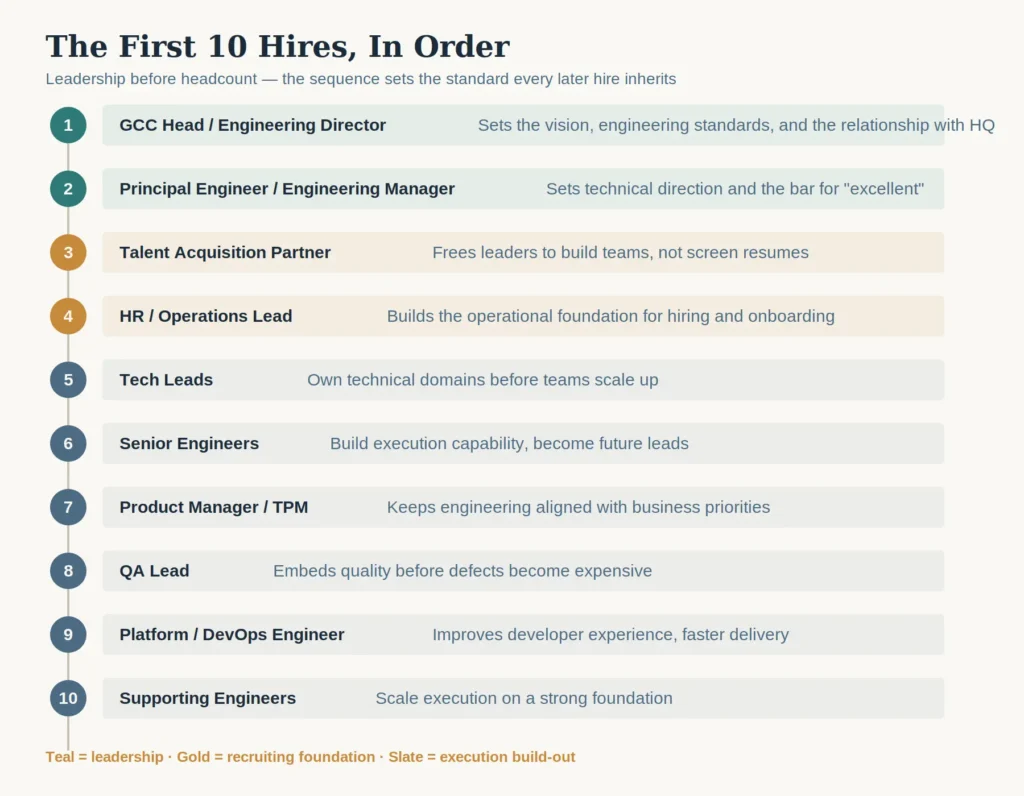
Notice what’s not first: engineers.
You’ve already written down what the centre owns. Now someone has to be capable of holding that against a headquarters that will, for the first year, instinctively take decisions back.
Most teams treat this as a senior req — write the JD, open the search, run the panel. The trouble is that the profile isn’t reachable that way.
The people who qualify are employed, delivering, and being approached by other companies this quarter. A job post reaches none of them.
There are three ways in, and you’ll likely use more than one.
Deputation. Send someone from HQ for six to twelve months. They aren’t running the centre long-term; they’re seeding how work gets done — review standards, escalation norms, what “done” means. It transfers culture faster than any document, and it has a hard limit, because a GCC led from HQ indefinitely never develops the judgment you set it up to acquire.
Relocation or transfer. Someone already inside the parent who moves. The trust is pre-existing, which is the whole point. The constraint is supply: this person exists or they don’t, and no process manufactures them.
External search. A real market with genuine India depth. Eight to twelve weeks is normal, and compressing it is where miscalibration enters.
What to look for in a GCC Head
Functional depth gets someone shortlisted. It doesn’t predict anything. Four things do:
They’ve built. Managing a stable function of 200 is a different job from constructing one from four. Ask what they started, not what they inherited.
They hold ground in two directions. Credible to your leadership team, and credible in the India market when a senior candidate asks why they should join. Most people are strong in one direction.
They’re comfortable deciding without permission. A leader who expects autonomy inside a centre that routes everything upward will stall quietly. So will one who never tests the boundary. Ask about a decision they deliberately kept local, and what it cost them.
They tell you when the charter is wrong. If the first conversation is agreement, you’ve learned nothing.
What roles can HQ seed in new GCCs, and what it can’t
This is where most build-outs waste six months trying to run something from headquarters that legally or practically cannot be.
| Role | Can HQ seed it? |
|---|---|
| Centre lead | Yes — deputation or transfer works, and often works best |
| Principal Engineer / architect | Yes — this role carries system context that only exists at HQ |
| First Tech Leads | Partly — pair a deputed lead with a local one |
| Talent Acquisition Partner | No. Sourcing depends on a local network. An HQ recruiter cannot fill a Staff Engineer role in Bengaluru. |
| HR / Ops lead | No. Payroll, PF, ESI, POSH, statutory filings and labour law are jurisdictional. |
| Finance / legal for the entity | No. Transfer pricing and local compliance sit with someone accountable in-country. |
| Engineers | No, past the first cohort |
The pattern to notice: everything requiring context can come from HQ. Everything requiring standing in the local market or under local law cannot.
The quarter that pays for itself
One thing worth doing before the centre scales past ten.
Send the first five to eight engineers to headquarters for a quarter. Not for training. For proximity — they sit near the people whose code they’ll inherit, they learn which decisions have history behind them, and they build the relationships that make a Slack message get answered in an hour instead of a day.
They come back as the people who can onboard the next twenty. That’s the compounding return, and it doesn’t happen if you send one person or if you send them for a week.
Where fresh faces stop being optional
A centre seeded entirely from HQ will build what HQ already builds. That’s fine for a delivery extension and fatal for anything meant to own a product.
Three points where local hiring stops being a cost decision:
Capability the parent doesn’t have. If the centre exists partly to build AI or data capability the parent is thin on, seeding from HQ transfers the gap.
Scale. You can depute two people. You cannot depute forty.
Independent judgment. At some point someone has to disagree with HQ and be right. People who came from HQ are structurally worse at this, through no fault of their own.
Then the hires start
Everything after the centre lead is a genuine recruiting problem, and the order matters: Principal Engineer, Talent Acquisition Partner, HR/Ops lead, Tech Leads.
Notice what still isn’t first: engineers. The first two roles set the technical bar before the team is large enough to argue about what it should be. And every week without a recruiter is a week your engineering leaders spend reading CVs.
1 to 25 engineers
Step 3: Design an Organization That Scales Beyond 10 Engineers Easily
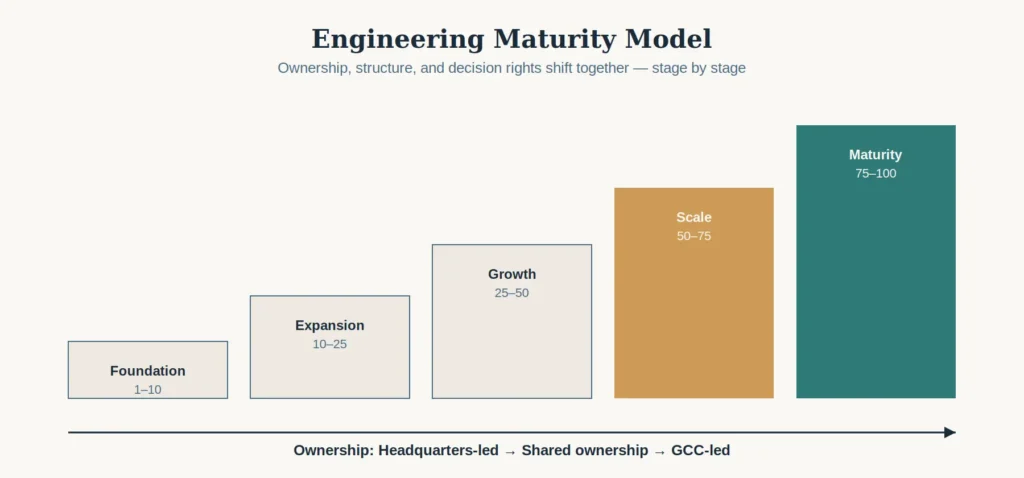
Reactive hiring assumes the org chart just grows in place. It doesn’t. The shape changes at each stage for a structural reason, not just a size reason.
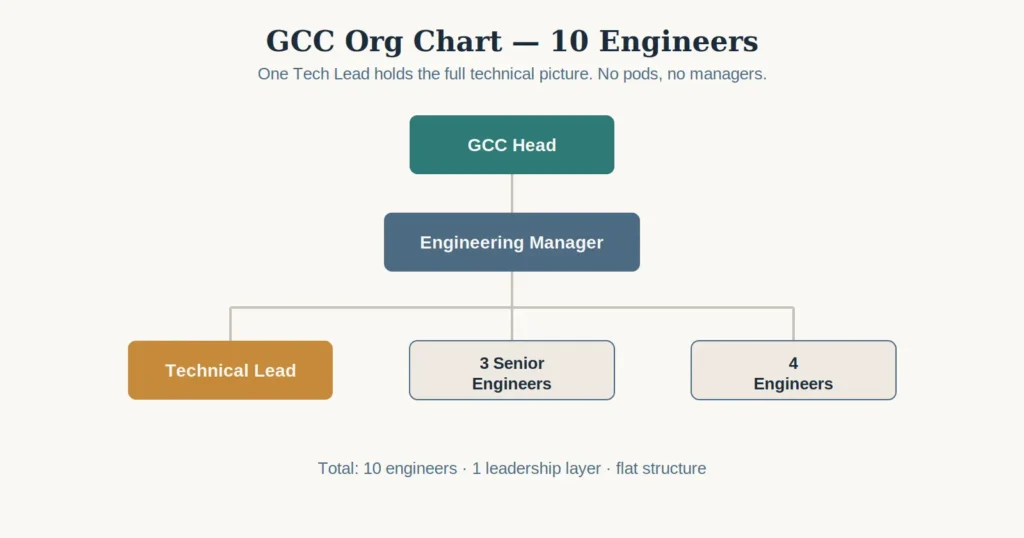
At 10, one Tech Lead holds the whole technical picture – no pods, no managers.
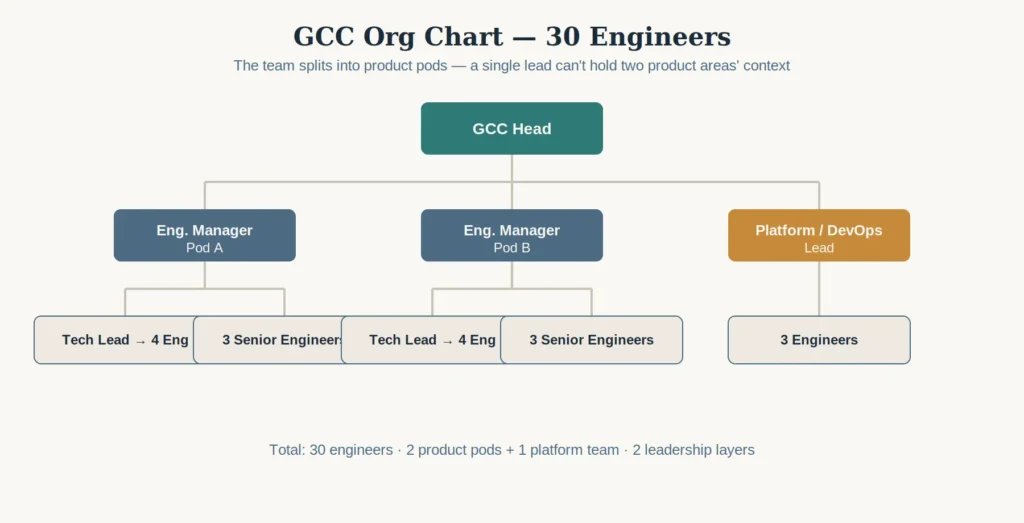
At 30, the team splits into pods because a single lead can’t hold two product areas’ worth of context.
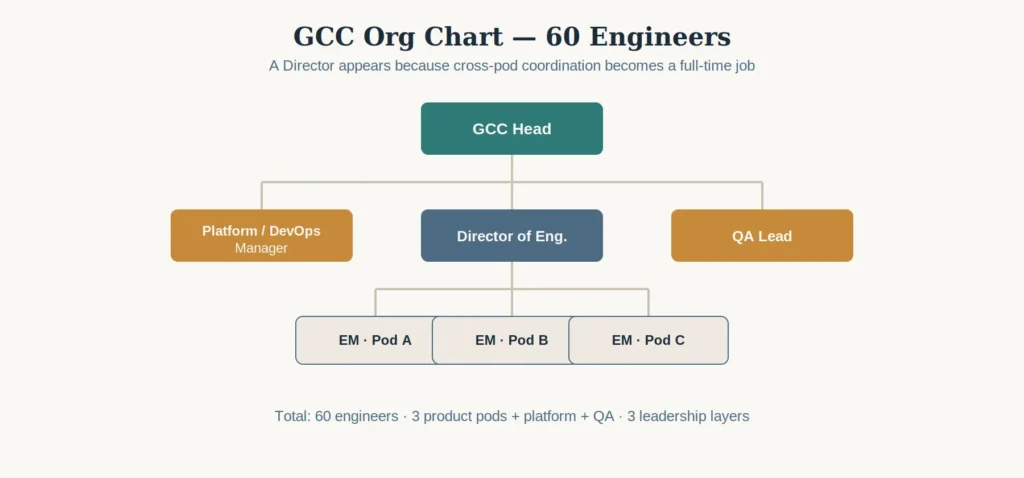
At 60, a director appears – not because the GCC head got busier, but because cross-pod coordination has become a full-time job.
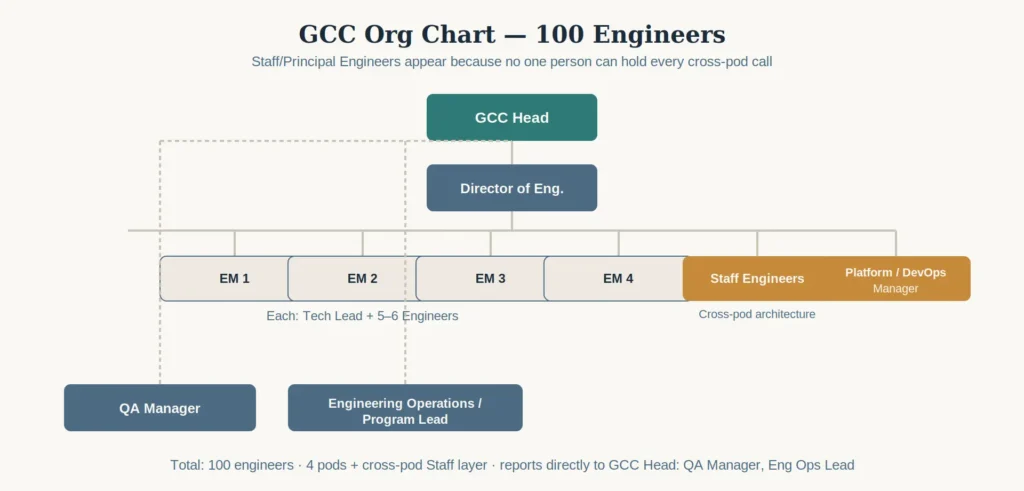
At 100, staff and principal engineers appear for the same reason: no one person can hold every cross-pod call.
What to do next: Redesign the shape at each stage transition on purpose, before the next hire forces it on you.
Template: Product Pod
Design your product pod
Adjust the roles, charter, and decision rights — the preview and copy-ready template update as you go.
Ten to twelve people is the right pod size at this stage – big enough to own a real slice of the product and small enough that the Tech Lead can still hold full context.
Template: Org Chart Builder
The org chart at 30 isn't a bigger version of the one at 10
The shape changes at every stage for a structural reason — not just a headcount reason. Pick a stage.
🟩 Rule of Thumb: The org chart's shape should change on purpose at each transition – pods at 30, a director at 60, and staff/principal roles spanning pods at 100 – not by accident after the hire that forces it.
Step 4: Build the Engineering System Before You Scale
By the time a GCC has 25 engineers, four things need to exist:
- A one-page charter per pod
- A documented Day 1 → 90 onboarding path
- Written coding standards and ADRs
- Interview scorecards calibrated across interviewers
Two of those are about the engineers you already have. Two are about the ones you're about to hire. Both halves break in different ways.
Template: Onboarding Milestones: Day 1 → 90
Day 1 → 90
This is where weak systems show up first — and where a new hire feels whether a GCC is organized or still figuring it out. Step through the four milestones.
🟩 Practical recommendation: Review Engineering documentation and Architecture Decision Records (ADRs) for every 25 engineers hired; waiting until it hurts means the current cohort has already missed it.
At a minimum, the following should be documented: a branching strategy, a PR checklist, a code review SLA, a definition of done, an ADR template, an incident process, and a deployment checklist.
Step 5: Give Talent Acquisition Teams The Right Tools
Campus hiring works. Just not yet.
Here's why: most GCC engineering hiring usually goes these two ways:
Bulk intake: freshers and early-career professionals.
Campus cohorts, near-campus lateral hires, engineers with under two years of experience. Almost nobody says the next part out loud: at 25 engineers you cannot absorb this method. Here's why:
Look back at the ratios. One senior or staff engineer per three to four juniors. At 25 engineers you might have six or seven people at that level and every one of them is already carrying something else.
Drop a fresher cohort on top and the mentoring load lands on exactly the people whose output you cannot afford to slow down.
Bulk intake becomes viable when a mentoring layer exists that isn't also the leadership layer. In practice that's past 50 engineers, once Tech Leads are running pods rather than building them, and it's the reason it belongs in your plan without belonging in your first year.
Lateral intake: experience and seniority.
Lower volume, higher stakes per hire. Tech Leads, Staff Engineers, domain specialists, the people from Step 2 whose judgment sets the bar everyone else inherits. And it's the only viable method to hire engineers, if your GCC is below 50 engineers.
Here's the part that trips teams up. These two streams get treated as separate hiring machines, with separate owners, separate rituals, and eventually separate standards. They shouldn't be.
Because every time, these following events do occur:
- technical screening/design or assessment rounds
- leadership or stakeholder rounds
- values rounds
And it's exactly why if you're just building a GCC, the hiring process should be similar. Only the weighting and the sourcing channels change:
| Round | Bulk intake | Lateral intake |
|---|---|---|
| Resume screen | Low signal (almost no history, near-identical profiles) | High signal, high noise (titles and employers need verifying) |
| Recruiter call | Interest and communication | Motivation and comp reality |
| Technical screening | Heaviest (fundamentals and learning speed) | Confirms baseline, rarely decides |
| Design / assessment | Scaled-down problem, tests reasoning not architecture | Heaviest (judgment under ambiguity) |
| Leadership / stakeholder | Light touch | Heavy for anyone setting direction |
| Values | Same both streams | Same both streams |
Sourcing Channels by Role For New GCCs
Role | Best Source |
Staff / Principal Engineers | LinkedIn Recruiter + warm referrals |
AI / ML Engineers | GitHub, Kaggle, research community networks |
DevOps / SRE | CNCF Slack, cloud-provider community forums |
| Backend Engineers | GitHub, referrals, campus/lateral hiring platforms |
| Architects | Existing leadership network, targeted outreach |
| QA Engineers | Job boards, testing-community groups, referrals |
Interview Funnel For New GCCs Below 100 Engineers:
The interview funnel
Same shape for every role — only the weighting changes. Pick a role to see which rounds carry the most weight, or tap any stage for detail.
🟦 Key Takeaways:
By 25 engineers, you should already have pod charters, an engineering handbook, interview scorecards, and a documented onboarding path. If one is missing, the scale eventually pauses.
Keep the same funnel shape across roles; vary only which rounds carry the most weight (for example, system design weighs more for staff engineers, and stakeholder rounds weigh more for engineering managers).

Hire, Augment, or AI? The GCC Leader's Playbook for Building Engineering Capacity
Read the piece →
Scaling Tech Talent In GCCs: What GCC Leaders Get Wrong (And What the Top 8% Do Differently)
Read the piece →
Building an AI Team in India: Lessons Every New GCC Leader Should Know
Read the piece →25 to 50 Engineers
Step 6: Scale Leadership In Appropriate Numbers as the Organization Grows
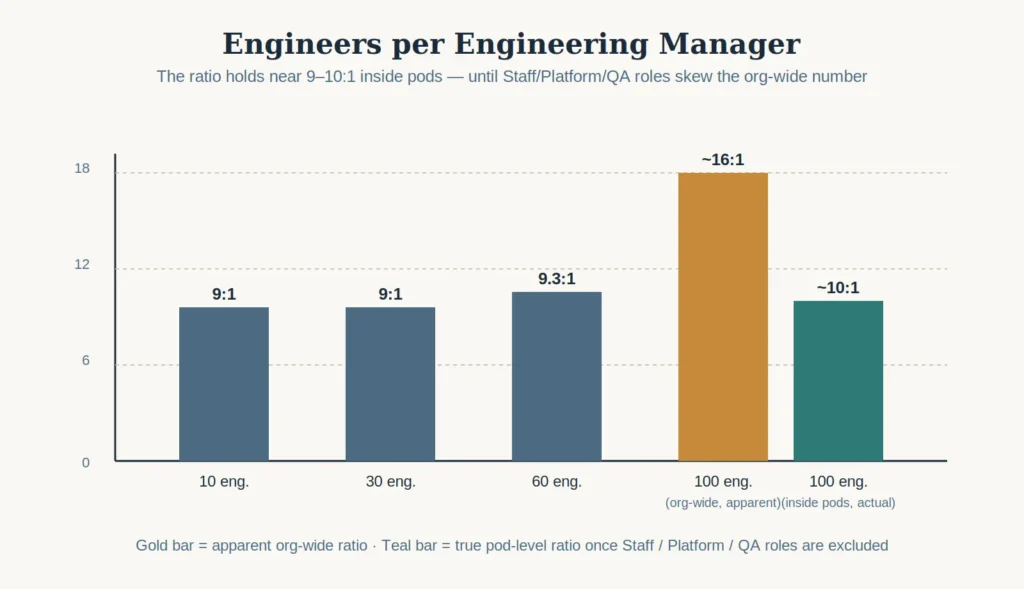
A 16:1 manager-to-engineer ratio at 100 people might look too high.
But look closer.
Not every engineer belongs to a product pod. Staff Engineers, Principal Engineers, Platform teams, and QA often have different reporting structures or support multiple teams.
If around 40 engineers fall into those groups, you're really managing 60 product engineers across six Engineering Managers. That's still about 10 engineers per manager, the same ratio you had when the organization was much smaller.
In other words, the number on the org chart changed. The day-to-day management load didn't.
Before you redesign your organization, make sure you know what the ratio is actually measuring.
Quick diagnostic – before blaming the ratio, check:
Read span of control correctly
A rising ratio isn't automatically a red flag. What are you actually seeing?
What's the symptom?
🟨 Watch For: A rising span-of-control ratio isn't automatically a red flag. Before restructuring, assess whether the issue is a genuine overload, a missing decision right, or undelegated authority.
Step 7: Make Promotions Predictable
Consistency is the solution. Teams that stall here usually have capable engineers but no shared answer to the question, "What does 'senior' actually mean?"
Build a career ladder with teeth: defined scope and decision authority per level, a minimum tenure, and a named sponsor per promotion. One staff engineer per 2–3 pods keeps cross-pod architecture coherent without creating a bottleneck.
Template: Career Ladder Snapshot
Promotions should never surprise anyone
Scope and decision authority per level, published before anyone asks why their peer got promoted. Tap a level.
🟥 Common Trap: Publish promotion criteria before an engineer asks why their peer got promoted and they didn't. Every promotion needs a named sponsor and a documented case to prove why the person is being promoted against other team members – not a verbal "They're ready."
Step 8: Scale Hiring Quality Without Slowing Down
Three hiring principles should remain constant:
- The same scorecard format for every candidate
- Submitted before the debrief, so the first opinion doesn't anchor the room
- Technical assessments are reviewed every six months – a fair bar at 20 engineers can be the wrong bar at 80
Practical recommendation: Track 90-day retention by sources, like referral, GitHub, LinkedIn, and job boards. A 20-point gap between your best and worst source is common, and it reflects a budget decision that is often overlooked.
50-100 Engineers
Step 9: Put AI On Both Sides Of The Hiring Line
Most GCC AI conversations stop at the IDE. Copilot for the engineers, a RAG assistant over the runbooks, done.
That covers one side of the line. The other side is the function that decides who sits in front of the IDE at all. And, at a GCC scaling past 50 engineers, that function is usually the bottleneck that sits unseen.
What engineering should automate
The test is the same one from Step 1: can the work be described completely before it starts?
Regression suites, release notes, boilerplate documentation, first-pass PR review, incident summaries, and ADR drafts all qualify.
Architecture, tradeoff calls, and anything requiring organizational context do not.
A repetitive gap gets a tool. A judgment gap still gets a hire.
What talent acquisition should automate
This is the half most GCCs leave on the table.
LinkedIn's Future of Recruiting 2025, surveying 1,271 recruiting professionals across 23 countries, found 37% of organizations were actively integrating or experimenting with generative AI in hiring (up from 27% the year before).
Among those teams, the average time saved was about 20% of the work week: a full working day, every week.
The number that matters more is where that day goes.
35% of those teams put it back into candidate screening, and 26% into skills assessment.
AI didn't shrink the recruiting team. It moved the team into different tasks, from coordination into judgment (which is exactly the move you're asking your engineers to make).
The quality signal follows.
LinkedIn's platform data shows companies whose recruiters use AI-assisted messaging most heavily are 9% more likely to make a quality hire than those using it least, and companies running the most skills-based searches are 12% more likely.
Small deltas. Compounded across 100 hires, they are the difference between a bench you trust and one you keep re-interviewing.
At bulk volume, hand-reading every CV stops being an option quickly. Screening tooling is how you get through the pile, and it does buy back real time.
What it buys is throughput. What it doesn't buy is a decision.
Which leads us to:
3 Things To Look Out For When Using AI In The Talent Acquisition Process
A scoring model built on one profile type will misread the other.
This is the failure we see most often. A model tuned on lateral CVs learns to read employer names, project scale, and title progression. Point it at a fresher pile where none of those signals exist and it falls back on keyword density.
As a result of which, it ranks the candidate who listed more technologies above the one who actually built something. The reverse fails too: a model calibrated for volume screening will happily pass a senior CV that's keyword-rich and thin on ownership.
Different profile types need different weight models. One scoring system across both intakes is one scoring system doing one of them badly.
CVs misstate things that only a call catches.
In our own submission QA we regularly find current employers listed that don't match the direct employer on the source document, timelines that can't be true, skills that vanished between one version of a CV and the next, and copy-paste errors carried between candidates. None of that is deception in most cases. It's how CVs get written. But no scoring pass catches it, and every one of them changes what the candidate actually is.
A screening model degrades quietly.
The candidate pool shifts, the roles shift, and the model keeps scoring against last year's shape. A bar that was fair at 20 engineers is the wrong bar at 80. Recalibrate on a cadence, the same six-month review you're already running on technical assessments, and check it against the two intakes separately.
The rule we work with: screening narrows the pile, the call decides. Nothing has replaced fifteen minutes on a call with a person, and we haven't seen anything close. According to LinkedIn's report, 89% of TA professionals expect measuring quality of hire to grow more important, while only 25% feel confident their organization can actually measure it. That gap is the hill where AI in tech recruiting can either die or thrive on.
🟨 Key takeaway: Engineering AI buys throughput. Talent AI buys a day a week that should be spent on screening depth, not on scheduling. Both are useless until the bar they're pointed at is written down and recalibrated often.
Step 10: Build One Engineering Culture Across HQ and the GCC
As a GCC grows, technical capability alone isn't enough. Clear decision boundaries, shared engineering practices, and trust with HQ are essential. Without them, routine decisions continue to flow back to headquarters, slowing delivery and limiting local autonomy.
Closing that gap takes structure, not aspiration:
- GCC engineers as contributors in architecture sessions, not note-takers
- Joint reviews where autonomy is demonstrated, not declared
- A documented GCC–HQ decision boundary that both sides can point to
🟨 Watch these signs: If GCC engineers are in the room for architecture decisions but not shaping them, that's a meeting invite standing in for actual trust.
Step 11: Establish Governance Before Complexity Does
As engineering teams grow, governance becomes essential for maintaining consistency and quality. Establish these core practices early, before scale makes them difficult to introduce.
- Architecture reviews are conducted every two weeks to ensure that technical decisions are consistent across teams.
- Security and compliance are built into engineering workflows from day one.
- Engineering standards are documented early on so that every team follows the same procedures.
Template: Architecture Review Agenda
Four sections, in this order. Fill them in as you go — the tracker at the bottom keeps itself up to date.
Problem
FilledWhat are we solving, for whom?
Alternatives
FilledAt least two, including “do nothing.”
Alternative 1 — always on the table
Do nothing. What happens if this stays as it is?
Alternative 2
Alternative 3 — optional
Tradeoffs
FilledCost, complexity, time-to-ship.
Cost
Complexity
Time-to-ship
Decision + Owner
FilledWhat we're doing, who's accountable.
Decision
Owner
Date
Template: Weekly Engineering Dashboard For GCC Heads
The engineering dashboard every GCC Head should check
Headcount tells you size. These seven numbers tell you whether the organization underneath it is actually working. Tap any metric.
Key Takeaway: Governance built by 20 engineers reads as "how we work here." Built all at once at 80, it reads as new rules from above – same content, opposite reception.
Step 12: Avoid the Mistakes That Stall GCC Growth
Pattern-match against these. Whiteboard fixes cost less than live org charts.
Cheap on a whiteboard. Expensive in a live org chart.
Tap a mistake to see why it happens, the better approach, and — for three of them — what it actually costs.
BONUS: A GCC Scaling Toolkit at Every Stage
Copy, adapt, use
Four milestones, checked off as you go. Your progress is saved in this browser.
Frequently asked questions
Conclusion
Where does your GCC stand today?
Drag to your current engineering headcount — see the stage, the primary goal, and the leadership focus that matters right now.
Every hiring milestone eventually becomes an organizational milestone. The question isn't whether your GCC will need new structures, leadership layers, or governance — it's whether you introduce them deliberately, or wait for growth to expose the gaps.
The strongest GCCs don't wait for growth to expose the gaps. They plan for the next stage before they arrive — that's what turns a growing engineering team into a long-term engineering organization.
BEEU TECH partners with engineering leaders to build scalable GCC engineering organizations — from leadership hiring and team design to operating systems and long-term capability.
Talk to us about your GCC engineering roadmap