

Key takeaway: AI is exposing workforce weaknesses that already existed. The GCCs pulling ahead are not necessarily hiring more AI talent. They are building a better workforce infrastructure.
Eighty-three percent of GCCs in India are already working with generative AI. Fifty-eight percent are actively building agentic capabilities, according to the EY GCC Pulse Survey 2025.
Yet, many enterprises still struggle to move beyond pilots.
So the automated GCC is not a scenario being planned for.
It is happening now, in production, across hundreds of centers.
But there are hiccups.
Here’s why: The talent conversation has not caught up.
It’s not that there’s not enough AI talent (sure, they are hard to obtain).
It’s just that AI has irrevocably changed the GCC operating model.
When GCCs were primarily delivery centers, a reactive approach didn’t deter outcomes.
But with GCC’s owning products, platforms, AI programs, and enterprise transformation, talent becomes more than a staffing function or a cost center
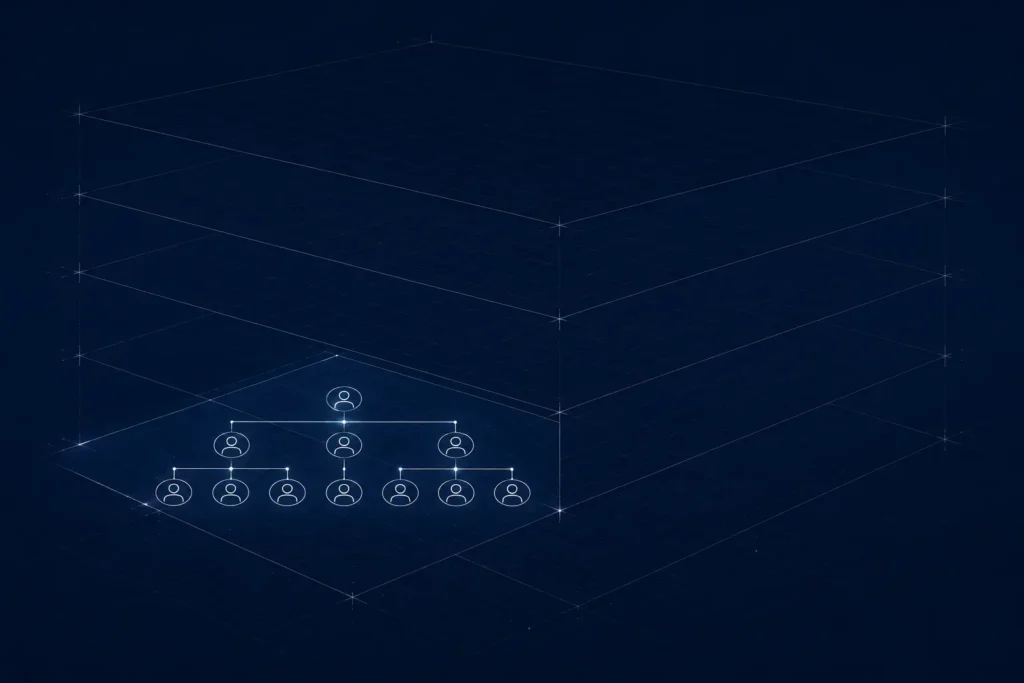
The top-performing GCCs increasingly treat talent as infrastructure.
And any infrastructure has rules.
Reliability.
Redundancy.
Observability.
Resilience.
Governance.
As AI reshapes how work gets done, those rules are becoming the difference between GCCs that scale to become innovation centers and GCCs that remain on the path towards becoming redundant.
Before we jump into how AI is changing the GCC operating model, let’s understand the following:
Written by
The Implementation Team
BEEU TECH — 6+ years delivering great tech and talent across enterprises & GCCs in India
Talent as Infrastructure: What It Actually Means
The phrase sounds strategic. The implication is more specific than most leaders realize.
When you treat a data center as infrastructure, you plan years ahead, build in redundancy, keep it running when costs get tight, and invest before you need it at scale.
Applying that logic to talent means: you build the pipeline before the role is open.
You identify successors before people leave.
You invest in upskilling before the skill becomes scarce.
You do not let the workforce plan be driven entirely by open requisitions.
Zinnov’s five-year GCC Landscape Report shows global leadership roles from India grew at a ~40% CAGR over the past five years, reaching 6,500+ roles in 2024. At that trajectory, Zinnov projects the number to surpass 30,000 by 2030.
Those roles are not being filled by people who were hired reactively.
They are being filled by people whose GCCs gave them P&L exposure, decision-making authority, and cross-functional ownership years before the global role existed.
This is what talent-as-infrastructure looks like from a leadership development perspective: you are not growing leaders for the org chart you have today.
You are growing leaders for the GCC that this center will become in three years.
The infrastructure is not just about headcount.
It is the institutional capacity to generate leadership from within.
If your GCC is still in the build phase — sequencing hires, getting leadership in place, figuring out decision rights — this piece on what the top 8% do differently covers that ground.
Talent Infrastructure Has The Same Properties As Technology Infrastructure
Every CIO understands technical debt.
Few think about talent debt.
Yet the consequences are remarkably similar.
| Infrastructure Problem | Talent Equivalent |
| Technical debt | Skills debt – not having supporting teams around AI pilots, scaling automation, without checking governance |
| Single point of failure | Key-person dependency – note building layers into the workforce |
| Lack of observability | Workforce blind spots – not having organizational structured data to improve productivity, hiring for the wrong metrics |
| Poor resilience | Attrition – best talent being poached away by competitive salaries and better EVPs |
| Weak governance | Unclear ownership – lack of a local leadership that helps mandate shared outcomes |
How Exactly Is AI Changing the GCC Operating Model
The AI narrative is running ahead of enterprise reality.
Many organizations have:
- AI pilots
- Copilots
- experimentation programs
- isolated automation initiatives
However, far fewer have successfully redesigned enterprise workflows around AI, at scale.
The gap is becoming increasingly visible.
More than 40% of agentic AI projects will be cancelled by 2027, according to Gartner’s predictions – the reasons: escalating costs, unclear business value, and inadequate risk controls.
Not because AI lacks capability.
Because organizations struggle with:
- governance
- data quality
- ownership
- security
- scalability
In other words:
The biggest barriers to AI adoption are often not technological.
They are organizational.
This distinction matters because many GCC leaders are still asking:
How do we hire more AI talent?
When the more important questions may be (and what top performers are already asking):
Is the organization ready to create value from the AI talent it already has?
What does our workforce look like when AI handles a third of what it currently does?”
Without structured data, governance models, and operational ownership, even the strongest AI teams may not drive the desired outcomes.
The answers change everything about how you plan, hire, promote, and protect talent
This article is about workforce infrastructure readiness – what that shift requires from leaders — and where most organizations are getting it wrong.
Talent scarcity is only a slice of a huge pie.
Here’s how AI is creating the talent as infrastructure in GCCs:
1. AI Is Going To Restructure Grunt Work In Enterprises, But Not Without Structured Data
The BCG GCC Playbook (June 2025) puts a number on what’s already moving: top-performing GCCs are reallocating 30–40% of their workforce from repetitive to higher-value tasks through AI deployment.
What that essentially translates into: repetitive roles are being subsumed into roles that require judgment (what required 100-member teams can run with 20 people within them – ones who can make judgments).
However, the GCCs that are pulling ahead are not the ones that cut headcount when automation arrived. They are the ones that designed this transition deliberately.
They redeployed before they were forced to.
They ensured their workforces were redistributed into three layers: core, specialist, and innovation roles.
Those that didn’t are now in a harder position: they have teams doing work that AI can do, and they lack the structural capacity to move those people into work that AI cannot do.
However, AI cannot just be dialed in at speed.
Governance, scale, and feasibility in AI pilots are three huge concerns.
Many organizations across the GCC and enterprise industries are still learning where AI creates durable productivity gains and where it creates temporary enthusiasm.
Hiring freezes, license reductions, and workforce reversals across major technology companies suggest the operating model is still evolving.
Institutional knowledge and IP are two things enterprises are extremely cautious about.
And AI cannot create value from fragmented, poorly governed, low-quality information.
The difference between basic and advanced AI use cases is rarely model sophistication.
It is data maturity that will help GCC teams move from basic deployments like
- coding assistants
- resume screening
- NLP chatbots
- hybrid voice/text workflows
To advanced deployments like:
- predictive forecasting
- AI-enabled product development
- hyper-personalized customer experiences
- enterprise process automation
The talent is important.
But structured data is what determines how much value that talent can create.
Without it, AI teams become highly skilled people, in waiting.
2. AI Talent Rarely Arrives Alone.
The average AI team has a 1:5 or 1:6 ratio.
Meaning, for every core AI scientist in a high-performing GCC, there are five to six professionals in adjacent disciplines — data engineering, platform engineering, MLOps, AI governance, and integration.
This data comes from the ANSR/Wizmatic AI Talent Trends in India’s GCCs Report 2025 – Fortune 500 GCCs in India have built a workforce of over 126,600 professionals in AI-aligned roles.
And the structure isn’t AI experts surrounded by generalists.
It is one AI expert supported by specialists who can govern, deploy, monitor, and scale what the expert builds.
Most GCCs are hiring as if they only need the 1. They are ignoring the 5.
The result is an AI team with no production infrastructure around it. Pilots that cannot scale.
Models that cannot be monitored. Systems that cannot be governed. The bottleneck is not the AI capability — it is the adjacent talent layer that operationalizes it.
What this means for talent leaders in GCCs:
The hiring plan is off if it only targets AI engineers. The plan needs to account for the full stack: data engineers, MLOps engineers, model evaluation specialists, cybersecurity professionals for AI systems, AI governance roles, and critically — AI-literate generalists who can use these systems in functional work.
That last category, what the LinkedIn Economic Graph calls “adoption talent,” is the largest and most under-hired layer of the whole workforce.
3. Standardization Enables People — But Only If You Design It Right
One of the structural shifts happening across mature GCCs is the move toward unified data layers and modular architecture — microservices built to be interoperable rather than monolithic. The BCG report identifies modular algorithms and microservices/API architecture as two of the top three differentiators between top-performing GCCs and the rest.
For talent leaders, this has a direct implication that rarely gets discussed.
Standardized systems — unified data, modular services, documented processes — are not just efficiency tools.
They are business continuity tools.
When a system is modular and documented, a senior engineer leaving does not create a six-week knowledge reconstruction crisis. The institutional knowledge lives in the architecture, not in the individual.
This is where intelligent process automation for repeatable processes earns its place.
Document collection, onboarding administration, compliance checks on routine filings, initial candidate screening logistics — these are processes that should be automated not primarily to save cost, but to free the human layer for work that requires judgment.
When your best engineers spend their hours on documented grunt work, they leave. Not dramatically. Quietly. They find a role where the work matches their level, and they go.
Automation of the bottom layer is how you keep the top layer.
4. Upskill, Redeploy, Then Replace
When AI automation displaces a function, the sequence matters.
Most organizations do it in the wrong order. They automate the role, see the headcount reduction, and then discover six months later that they are short on the adjacent capability that the displaced person was informally providing. The knowledge that lived in the person did not transfer to the system.
The right sequence:
Identify which roles are being automated → redeploy the person into the adjacent role that the AI system now needs human oversight on → backfill the original role with an AI tool → hire for the new judgment-intensive role that now exists.
This is not a philosophical commitment to no-layoff policies.
It is a practical recognition that in a GCC context, institutional knowledge is expensive to rebuild, and the people who have it are the same people whose roles AI is changing. They are your fastest path to the adjacent capability you need.
Upskilling the people you already have is almost always faster and cheaper than finding new people who already have the skills. Not universally — there are capability gaps that require external hiring, specifically in deep AI engineering and MLOps.
But for the majority of roles that AI is changing at GCCs, internal redeployment with structured learning is the faster path.
5. AI Leadership Has to Come From Inside the Org
There’s a number that should be uncomfortable for anyone running a GCC.
Two-thirds of CEOs say they personally use AI. Their average usage: 1.5 hours a week. Meanwhile, the engineers, analysts, and ops leads those same CEOs manage are embedding AI into the majority of their daily workflows — and according to McKinsey, C-suite leaders estimate only 4% of their workforce uses gen AI heavily, when the real figure is three times higher.
Leadership’s mental model of AI adoption is calibrated to what they see from their own desk. Not what’s actually happening below them.
This creates a specific failure mode in GCCs.
When the person making workforce decisions — headcount, redeployment, attrition tolerance, AI investment — is using AI for 90 minutes a week, they’re making those decisions from the outside of the tool’s actual capability.
They’re planning around a version of AI they’ve experienced as a time-saver. Their teams are experiencing it as a workflow replacement.
The gap isn’t awareness. Every senior leader knows AI is important.
The gap is fluency — and fluency, in this context, means knowing firsthand which work the tool can hold, where it breaks down, what it needs from humans to function, and what happens when it’s given bad data or ambiguous prompts (or worse, hallucinates).
Without that fluency, the decision to reduce headcount because “AI handles it now” gets made without understanding what the AI is actually handling and what’s still silently being held together by people.
And when those people leave, workforce gaps surface, through delivery timelines that start slipping and escalations that have no one to absorb them.
In our experience working with GCCs and enterprises, we’ve seen the GCCs that make better decisions about AI have leaders in the work.
Running prompts, breaking down the outputs, understanding where the guardrails matter, sitting with the team when a model fails in production, and figuring out why.
That’s the difference between a leader who mandates AI adoption and a leader who can design an AI-integrated workforce that doesn’t collapse when the model hallucinates or the data pipeline goes stale.
This isn’t an argument for every GCC head to become a prompt engineer.
It’s an argument for enough fluency that workforce decisions are grounded in operational reality rather than boardroom assumptions about what AI is really replacing.
6. Business Continuity Comes With Humans in the Lead
Not every process in a GCC should be automated, even if it can be.
For regulated environments — financial services, healthcare, pharmaceutical, and legal — certain decisions carry compliance exposure that makes full AI automation structurally inadvisable.
Compensation analysis benchmarked against live market data needs human sign-off before an offer goes out. Background verification results need human review before a hire is confirmed. Decisions affecting regulated data pipelines need a human in the loop who can be accountable.
We can chalk it up to good ol’ risk aversion architecture.
The GCCs that have operationalized AI well are the ones that drew the line deliberately — process by process, with clear reasoning for where the human layer sits and what it is accountable for.
Where AI Belongs in Talent Decisions — And Where It Does Not
This is where the conversation needs to get uncomfortable.
Recruiters increasingly flag AI-optimized resumes as indistinguishable from each other — and the signal problem runs in both directions.
The system screens out qualified people; the candidates learn to game the system; and neither side gets better information.
And it gets worse:
Firms are holding more interviews than ever in 2026 – and the average time-to-fill is already sitting at 45 days.
In our experience delivering tech talent, we’ve seen that the time to onboard the traditional way, for specialized tech roles, often stretches to 90+ days
A February 2026 paper published on arXiv — “Quantifying Algorithmic Friction in Automated Resume Screening Systems” by Ibrahim Denis Fofanah at Pace University — introduces the concept of “algorithmic friction” in hiring pipelines.
The finding: keyword-based ATS systems exhibit high false-negative rejection rates caused by semantic misinterpretation. Qualified candidates are made invisible before human review — not because they lack capability, but because their language did not match the system’s keyword logic.
The Harvard Business School Hidden Workers Study put an employer-side number on this: 88% of companies believe their ATS screens out highly qualified candidates.
They know it is happening. They continue because the volume problem feels bigger than the quality problem.
For GCC hiring, this creates a specific failure mode that talent leaders see and rarely name.
People clear the technical rounds. They pass the system’s filters. They make it to the final stage. And then they do not get selected — because the fit is not there.
Not “would I want to get a beer with this person” fit.
Functional fit: can this person handle direct feedback when it is critical? Do they find their way around roadblocks, or do they escalate everything upward?
Do they take ownership of ambiguous mandates, or do they wait for instruction?
These are not assessable by any ATS.
They are not reliably assessable by AI-led interviews either.
Tech skills are learnable. Culture fit failure in GCCs typically surfaces 4–6 months in, after full ramp-up cost has been absorbed — and no ATS knows how to catch it.
The clean line for AI in talent decisions:
AI belongs here: document collection, initial resume parsing for baseline qualification, scheduling, background verification logistics, compensation band benchmarking using verified market data.
Humans belong here: final evaluation, culture assessment, leadership potential judgment, compensation negotiation, succession decisions. Human-led, AI-assisted — not the other way around.
The GCCs that are getting this right have not banned AI from hiring. They have defined where it sits in the chain and where it stops.
Talent Observability: Measuring What Actually Matters
Most enterprises have sophisticated observability systems for technology.
They can detect:
- latency
- outages
- infrastructure failures
- performance degradation
Yet many have almost no visibility into workforce health.
Instead they monitor:
- headcount
- hiring volume
- overall attrition
Those metrics tell leaders what already happened.
Not what is about to happen.
The GCCs pulling ahead increasingly monitor:
- critical skill concentration
- leadership bench strength
- internal mobility rates
- AI adoption effectiveness
- high-performer attrition
- capability gaps in emerging domains
Observability is not measurement.
It acts like an early warning system.
Seven Things Talent Leaders and CIOs Should Do Now
These are decisions, not aspirations.
1. Audit your current headcount against the 1:5–6 ratio.
For every core AI specialist you have, how many adjacent-role professionals do you have supporting them? If the ratio is 1:1 or 1:2, your AI teams are under-resourced to scale to production.
2. Define the AI-stop line in your hiring process.
Document which steps in talent acquisition are AI-led and which require human judgment. Communicate this to your recruiting function. Review it every six months as tools change.
3. Map your automation roadmap to a redeployment plan.
Before you automate a function, identify where the people doing it will go. Build the skill bridge before the role disappears.
4. Separate overall attrition from high-performer attrition in your tracking.
An EY GCC Pulse Survey average attrition of 12.5% obscures what matters: if your top performers are leaving at 20% while your overall rate looks fine, you have a serious problem that the headline number is hiding.
5. Build dual-track career paths before your best domain experts leave.
If the only promotion path leads to people management, your best technical people will eventually leave for organizations that have a principal engineer or staff engineer track. Build the path before you lose them.
6. Give local leadership real decision rights — in writing.
Document what your GCC head can decide without HQ approval. If the list is short, it is a retention problem waiting to become an attrition event.
7. Protect the human evaluation layer in hiring.
Use AI to reduce volume and logistics friction. Protect the final evaluation stage for human judgment — specifically on the dimensions that predict whether someone will thrive in your specific environment: feedback tolerance, roadblock behavior, ownership under ambiguity. These cannot be scored by a keyword system.
Which Roles Are Actually Changing?
The question leaders increasingly ask is not:
“Will AI replace jobs?”
The more useful question is:
“Which work is becoming more valuable?”
Several categories of work are already becoming more automated:
- L1 support
- repetitive QA
- manual reporting
- documentation-heavy operations
- transactional shared services
At the same time, demand continues to rise for:
- AI governance
- AI operations
- data engineering
- platform engineering
- AI product ownership
- model observability
- human-in-the-loop quality assurance
The shift is not from people to AI.
It is from execution to judgment.
The workforce that benefits most from AI is the workforce positioned above the automation layer rather than inside it.
The Workforce That Survives Automation Is the One You Build Before It Arrives
The GCCs that will be in the top 8% five years from now are making workforce decisions today that look premature to everyone else. They are hiring adjacent roles before the AI teams need them. They are redeploying before the function disappears. They are building leadership tracks for people who are not ready to lead yet.
The ones that will be stuck are the ones treating talent as a variable cost — something to be adjusted when the automation savings show up on the spreadsheet.
Talent as infrastructure does not mean never reducing headcount. It means treating your workforce with the same planning discipline you apply to your technology stack. You do not let your data infrastructure degrade until it fails. You do not let your talent infrastructure run on reactive hiring and hope.
The AI transition in GCCs is not a threat to the workforce. It is a pressure test on whether the workforce was built well enough to absorb change. The ones built on trust, ownership, and capability depth will absorb it. The ones built on headcount and task execution will not.
BEEU TECH helps enterprise organizations build GCC teams that are ready for the AI transition — from initial buildout through talent strategy and workforce planning. Learn about our GCC BuildPod program.