


Every GCC leader in India is under pressure to scale engineering capacity quickly. The question: Should we hire more engineers, use staff augmentation, or lean on AI to move faster?
It’s an understandable instinct.
Headquarters wants products shipped faster. AI is changing engineering expectations. Every headline talks about GCCs becoming innovation and product engineering hubs instead of delivery centers.
Meanwhile, more than 2,100 GCCs are competing for the same engineering talent in India.
The natural response is to hire more people, faster.
BUT, in our experience delivering tech talent across GCCs, we’ll tell you NOT to do that.
Here’s why: GCCs that earn greater ownership from headquarters separate engineering capacity from engineering capability.
Engineering Capacity vs. Engineering Capability
Engineering capacity indicates the total workload your GCC’s engineering teams can execute.
Engineering capability, however, determines what work headquarters is willing to trust you with.
For years, increasing capacity meant increasing headcount. AI changes that equation.
It changes how engineering work gets done.
And that’s precisely where many GCCs get it wrong.
They treat AI as another hiring option. 🙂
The strongest GCCs use AI as an operating model to change how work flows across the engineering organization.
📌 Key Takeaways
- Permanent hiring can help build long-term capability.
- Staff augmentation expands execution capacity.
- AI systems can help increase the output of both, but they don’t replace engineering. Architecture, judgment, and ownership still depend on people.
- There’s no universal model. The right talent mix evolves as a GCC grows.
- Organization design comes before recruitment.
- Augmentation has three forms: individual engineers, managed pods, and acqui-hires (each offering a different level of ownership and flexibility).
- The biggest staffing mistake? Measuring success by headcount instead of the business ownership the GCC earns.
This piece will help you decide which creates the greatest advantage as your GCC grows, namely:
When to choose permanent hiring.
vs.
When to choose staff augmentation.
vs.
When AI should do the work instead.
The Engineering Capacity Strategy Every GCC Leader Must Get Right
A great engineering capacity strategy balances talent, expertise, and AI for sustainable growth.
But how?
This exact question was a recurring theme at the ETGCCWorld GCC Growth Summit 2026 in Pune, where engineering leaders from Sulzer, Kimberly-Clark, Domo, Ensono, and Diebold Nixdorf agreed on one point:
There is no single staffing model that works at every stage of a GCC’s growth.
A 15-engineer GCC needs something very different from a 150-engineer one. The better question isn’t: “Which staffing model is best?”
It’s “Which one builds the capability your GCC needs next?”
| GCC Stage | Priority | Typical Talent Strategy |
| 0–25 engineers | Speed + leadership | Direct hiring + augmentation + AI |
| 26–99 engineers | Ownership + flexibility | More permanent hiring + selective augmentation |
| 100+ engineers | Scale + capability maturity | Permanent teams + specialist partners + AI |
What Leading GCC Engineering Leaders Are Saying
At the ETGCCWorld GCC Growth Summit 2026 in Pune, engineering leaders from Sulzer, Kimberly Clark, Domo, Ensono, and Diebold Nixdorf highlighted a common reality: technology is evolving faster than hiring cycles. Their insights reveal why GCCs must rethink how they build engineering capability.
Hire for learning agility, not just current skills
(Saurabh Gupta, GM & Site Head, Sulzer Business Services, Pune)
Roles are becoming obsolete faster than ever. The engineers who create the most long-term value are those who combine deep technical expertise with the ability to continuously learn and adapt. Hiring solely for today’s skills is a short-term strategy in a fast-changing technology landscape.
Hire for tomorrow, not just today’s gaps
(Sandeep Poddar, Chief Architect, Kimberly Clark GCC Pune)
The most expensive hiring mistakes happen when recruitment is driven only by the current sprint backlog. Every hire should solve an immediate business need while also strengthening the organization’s future capabilities. The best engineers are those who can grow into future technical leaders, architects, or product owners as the GCC evolves.
Develop leaders with customer focus
(Ashfak Shaikh, Senior Director, Domo India)
Technical excellence remains essential, but future engineering leaders will be defined by more than coding ability. Understanding customer problems, engaging with business stakeholders, and building products with empathy are becoming equally important leadership qualities.
Measure value, not just cost
(Veena Khandke, SVP & Managing Director, Ensono India)
In the early stages, many GCCs are judged by cost efficiency. As they mature, success is measured by the business value they create. The shift from execution to ownership requires leaders to focus on innovation, outcomes, and strategic impact – not simply delivery at the lowest cost.
Reskill talent before replacing it
(Diwakar Rai, Country Head – Retail Software & GCC, Diebold Nixdorf India)
When technology changes, replacing people isn’t always the best answer. Existing employees are familiar with the company’s products, culture, and engineering practices. Investing in reskilling and redeploying them often delivers greater long-term value than starting over with new hires.
Despite their different perspectives, they all reinforce the same message:
For modern GCCs, capability (not headcount) is the true measure of success. Translating that principle into action requires GCC leaders to rethink how they combine permanent hiring, external expertise, and AI-driven productivity.
Source: Economic Times
Hiring AI Engineers Or Frontend Devs? Compare the costs first.
Select your hiring region, choose your team size and compare the true cost of building an in-house engineering team against hiring remotely through BEEU TECH. Includes recruitment costs, employment overheads and projected annual savings.
Hire, Augment, or Scale With AI? The Three Models Shaping GCC Engineering Capacity
The real impact of AI in GCCs shows up in what engineers can take on next.
It was never about how many processes are running autonomously (or the cost optimization).
In our 6+ years of delivering tech talent, we have observed GCCs often gain short-term efficiency when they use AI to replace talent.
But often at the cost of domain expertise and the opportunity to create lasting value.
As Gupta noted at the ETGCCWorld GCC Growth Summit 2026, AI readiness starts with foundational literacy and grows through real-world application. Khandke likened AI learning to learning a new language—without the fundamentals, teams cannot unlock its full potential.
The goal is always to use AI as a multiplier.
Engineers continue to drive judgment, ownership, and innovation – faster.
The Three Strategic Levers for Building Engineering Capacity
| Decision | Best When | Avoid When |
| Direct Hiring | Developing long-term capabilities, domain ownership, and strategic engineering depth | The requirement is temporary or the future capability roadmap is still evolving |
| Staff Augmentation | Adding specialized expertise quickly to accelerate defined initiatives | Critical architecture, IP ownership, or core decision-making is involved |
| AI-Enabled Engineering | Increasing engineering throughput and improving execution across repeatable workflows | Strategic judgment, complex problem-solving, or ownership cannot be delegated |
The decision is not simply whether to hire, augment, or automate. The real question for GCC leaders is: How do you build an engineering organization where human expertise and AI capability compound each other?
Thinking of hiring for AI?
Hire AI engineers from India for AI teams in the US, UAE, and India through BEEU TECH
Built for enterprise hiring. Vetted AI engineers on remote basis from India, working in your timezone. A one-week paid trial comes first, you expand or scale down as the roadmap moves, and offboarding runs on 15 days notice.
- One-week paid trial
- Your timezone
- Transparent management
- 15 days notice to offboard
Deployment in as fast as 72 hours. Over six years placing tech talent with enterprise teams and GCCs.
6 Engineering Principles That Change How GCCs Build Engineering Capacity
Most GCCs don’t really struggle to hire engineers. Growing headcount is the easy part.
But building an engineering organization that HQ trusts with products, platforms, and strategic decisions? Much harder.
That’s the difference between a GCC that executes work and one that shapes business outcomes.
So, what’s the secret sauce?
1) Early hires reduce dependency on HQ
What this means for you: Your first engineering leaders should be able to make technical decisions without waiting for HQ approval. Be it engineering standards, decision-making habits, or the culture every future hire inherits.
2) Consistent outcomes drive teams
What this means for you: Orchestrate engineering teams to deliver predictable releases while having a direct impact on business outcomes. Trust comes from a place of consistency.
3) Product ownership shapes hiring
What this means for you: Hire for the organization you want to build, not just the work you need today. Early hires should be capable of leading products, making architectural decisions, and mentoring future teams.
4) Coordination is what gets automated first
What this means for you: Invest in automating release notes, sprint planning, documentation, test generation, incident summaries, architecture discovery, or onboarding. Those are the activities that consume engineering hours across every team.
5) Good organizational design compounds
What this means for you: Every engineering leader should leave behind a system. If removing one person slows the organization, you’ve hired talent, not built capability.
6) AI is often the founding part of engineering teams
What this means for your GCC: Treat AI as the first additional team member, not the last. The fastest-growing GCCs don’t hire more engineers until they’ve the tools to support actual engineers when they join in.
The goal isn’t to hire more engineers. It’s to build an engineering organization that progressively earns HQ’s trust for greater ownership.
Is Your Talent Strategy Ready for the Next Stage of GCC Growth?
The talent strategy that helps a GCC launch isn’t the one that helps it scale. As the organization grows, its priorities shift – from building trust to owning products to creating long-term engineering capability. Your hiring strategy should evolve with those priorities.
Stage 1: 0-25 Engineers – Build Trust
At this stage, the priority isn’t building a large team – it’s proving that the GCC can deliver consistently. Every early hire shapes the engineering culture, credibility, and confidence that HQ places in the center.
Focus
Earn HQ’s trust by delivering consistently while laying the foundation for long-term engineering capability.
Recommended Talent Mix
- A small core team of experienced permanent engineers
- Staff augmentation for speed and flexibility
- AI tools to improve engineering productivity
Leadership Priority
Establish engineering standards, delivery discipline, and clear ownership from day one. Establish credibility by consistently delivering before asking for bigger responsibilities.
Common Mistakes
- Hiring for headcount instead of quality
- Delaying leadership hires
- Using augmentation without a knowledge-transfer plan
Stage 2: 26-100+ Engineers – Build Ownership
Once the GCC has earned credibility, expectations change. The conversation moves from “Can the team deliver?” to “Can the team own?” This is where successful GCCs transition from execution centers into product engineering organizations.
Focus
Move beyond delivery and start owning products, platforms, and business outcomes.
Recommended Talent Mix
- Increase permanent hiring for strategic roles
- Use staff augmentation selectively for specialist or temporary needs
- Continue expanding AI adoption across engineering teams
Leadership Priority
Strengthen middle management, build clear career paths, and measure success through business outcomes – not just project completion.
Common Mistakes
- Making augmentation the default operating model
- Underinvesting in leadership development
Stage 3: 100+ Engineers – Build Capability
By this stage, the team has already established delivery and ownership. The priority now? Building a mature engineering organization that can scale independently, adapt quickly, and create long-term business value.
Focus
Build world-class engineering, strong leadership, and move towards becoming a mature organization.
Recommended Talent Mix
- Permanent teams for core engineering functions
- Specialist partners for niche expertise
- AI embedded across the engineering lifecycle as a standard way of working
Leadership Priority
Develop future leaders, strengthen governance, build capability across teams, and use AI-driven workforce planning to stay ahead of evolving skill requirements.
Two frameworks become particularly valuable at this stage:
- 10–30–50 Rule (Avneet Hora, CHRO, ANSR): Aim for approximately 10% of leadership roles, 30% of the workforce, and 50% of emerging AI and technology skills to reside within the GCC, demonstrating that the center is shaping strategy – not simply executing work.
- Redeployability Index: Percentage of talent that can be redeployed to critical priorities within 90 days. A strong index means the GCC can pivot quickly as business needs evolve.
The 10–30–50 rule, applied to your numbers
Based on ANSR CHRO Avneet Hora’s framework for mature GCCs (100+ engineers), plus a quick read on redeployability. Enter your figures below.
Common Mistakes
- Treating headcount as the goal instead of capability
- Underinvesting in leadership depth and succession planning

Scaling Tech Talent In GCCs: What GCC Leaders Get Wrong (And What the Top 8% Do Differently)
Read the piece →
Talent As Infrastructure In Enterprises & GCCs: What CIOs Need To Prepare For
Read the piece →
Building an AI Team in India: Lessons Every New GCC Leader Should Know
Read the piece →5 Talent Strategy Challenges Every New GCC Faces
1. Keeping Major Decisions with HQ for Too Long
If architecture, hiring, and technical decisions always need HQ approval, the India team never develops real ownership or decision-making capability.
2. Hiring for Today’s Needs Instead of Tomorrow’s Organization
The first hires don’t just deliver work – they influence future hiring standards, engineering culture, and leadership quality.
3. Focusing Only on Knowledge Transfer
Learning existing systems is necessary, but the team builds long-term capability by designing, building, and improving products independently.
4. Growing Headcount Without Growing Capability
Adding more engineers increases capacity, but it doesn’t create a stronger organization unless responsibility and expertise grow with it.
5. Promoting People Because the Organization Is Growing
Rapid growth often leads to early promotions. Leadership must be earned by capability alone, not because there’s a vacancy.
A Practical Decision Framework for GCC Heads
Every time a new capability need surfaces – a new product area, a new technology, a gap in your delivery – run it through these five questions before deciding how to staff it.
Is this capability strategic? ↓ Will we need it for three or more years? ↓ How quickly do we need it? ↓ Do we already have leadership to support it? ↓ Can AI increase productivity here before we add headcount?
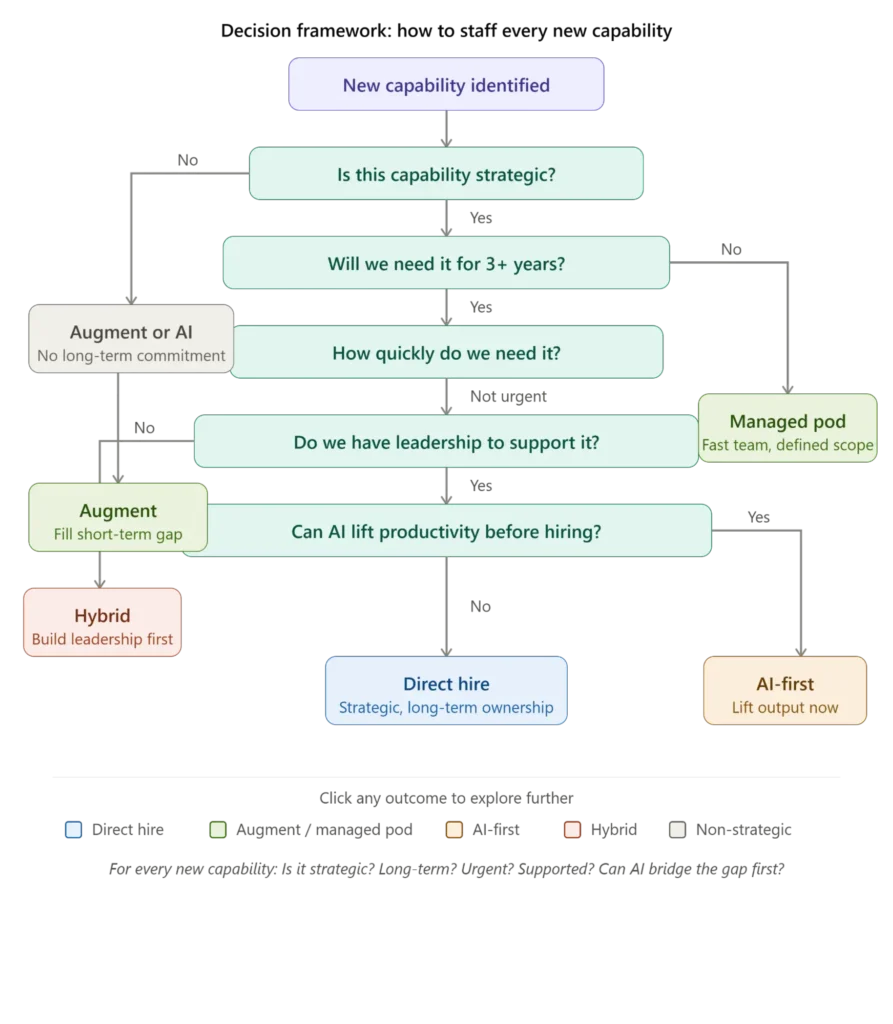
⬇ Decision Framework: How to Staff Every New Capability
The answers point to one of five paths:
| Path | Best suited when… |
| Direct Hire | The capability is strategic, long-term, and you already have leadership to support it. |
| Augment | The need is urgent, clearly defined, and short-to-medium term. |
| Managed Pod | You need a complete engineering team stood up quickly under a delivery partner’s management. |
| AI-First | AI can significantly improve engineering productivity before additional hiring is required. |
| Hybrid | The situation calls for a phased combination of direct hiring, augmentation, and AI. |
Key takeaway
If you remember only one principle from this framework, let it be this:
- Build permanent teams for capabilities you want to own.
- Use augmentation when speed and flexibility matter most.
- Use AI to multiply engineering productivity – not replace engineering talent.
KPIs Every GCC Leader Should Track to Measure Engineering Capacity
Choosing the right staffing model is only half the challenge. Measuring whether it is improving engineering capability is equally important.
Headcount was never an outcome. The metrics below provide a far better view of whether your GCC’s engineering talent strategy is creating long-term organizational strength.
| KPI | What it Measures |
| Delivery Velocity | How quickly engineering teams move work from commit to production. |
| Sprint Predictability | Percentage of sprint commitments delivered on time. |
| Defect Escape Rate | How many defects come up in production vs the number that came up in testing. |
| Time-to-Hire | Time to full ownership for new engineers. |
| Time-to-Productivity | How long it takes a new engineer to contribute independently. |
| Product Ownership Index | The percentage of roadmap decisions owned by the GCC without HQ intervention. |
| Attrition Rate | Annual percentage of engineering talent leaving the organization. |
| AI Adoption Rate | Percentage of engineers with active AI tooling in their workflow |
Tracking these KPIs consistently gives GCC leaders a clearer picture of whether their engineering capacity is becoming more resilient, productive, and capable of taking on greater business ownership – not simply growing in size.
What to track once headcount isn’t the whole story
Tap any metric to see what it measures and why it matters.
Frequently Asked Questions
Should a GCC hire directly or use staff augmentation?
It depends on the time horizon. Direct hiring makes sense for capabilities you’ll need for years and want the GCC – not a vendor – to own long-term, like architecture or product decisions. Staff augmentation makes sense for urgent, short-to-medium-term needs, like a fixed-scope project with a hard deadline.
What is a managed engineering pod?
It’s a form of staff augmentation where a delivery partner provides a complete team – including its own management layer – to own a defined scope of work, rather than individual engineers slotting into your existing squads.
Will AI replace the need to hire engineers in a GCC?
No. AI tools can now generate up to 40% of standard code and handle initial testing, which changes how engineers spend their time – shifting focus toward architecture, problem-solving, and system design. It doesn’t remove the need for engineering judgment, leadership, or ownership, which still require people.
At what size does a GCC need to shift its hiring strategy?
Roughly three inflection points: under 25 engineers, prioritize speed through a hybrid of direct hire, augmentation, and AI; between 26 and 99 engineers, shift toward permanent hiring and product ownership; past 100 engineers, focus on leadership depth and capability maturity, using augmentation and AI selectively rather than as a baseline.
What’s the difference between building an engineering team and building an engineering organization?
A team executes tasks. An organization owns outcomes – meaning headquarters trusts it to make decisions, not just deliver output. The distinction shapes hiring: early hires should include people who can eventually own a product or module, not just build it.
What is the 10-30-50 rule for GCC workforce design?
A framework proposed by ANSR’s CHRO Avneet Hora: roughly 10% of an organization’s leadership roles, 30% of its total workforce, and 50% of its emerging AI/tech skills should sit inside the GCC – signaling that the center shapes strategy rather than just executing tasks handed down from headquarters.
Evolve the Mix, Don’t Fix It
The strongest GCCs don’t win by picking one staffing model. They win by changing the mix as the organization matures.
We build all three sides of that mix. GCC BuildPod for the early core team that sets the culture every future hire inherits. BEEU RemoteHire for the specialist capacity a roadmap can’t wait on. Agentic AI for the repeatable work that doesn’t need a person sitting on it.
We’ve watched GCCs hire out of panic after a senior engineer quits, backfilling for continuity instead of capability. Every week that new hire spends ramping up is money the GCC already spent twice.
What actually survives a departure is the system the senior engineer was part of, not a replacement for them. That’s what we build alongside the talent delivery: the systems, standards, and ownership structures that outlast any one hire.
Every GCC stage asks the same question: which lever gets you to ownership fastest, hiring, augmentation, or AI. That’s the conversation we have with GCC heads every week.
Talk to us about staffing your next stage, not just your next hire.
Build your GCC capacity plan →Sources
- ANSR – Global Talent Trends for GCCs 2026 – Source for the 40% standard code generation statistic and GenAI adoption data.
- ANSR – Critical Global Talent Trends for Capability Centers in 2026 – GlobeNewswire press release, February 17, 2026.